Local Shops Increase Repeat Customers With QR Rewards, No App Needed
Local Shops Increase Repeat Customers With QR Rewards, No App Needed

To increase repeat customers, fix the post-purchase experience, launch a simple reward people can claim in seconds, follow up with personalized email or SMS, and track your repeat customer rate every week. Retention research cited by Bain and HBR shows why it pays. Our app-free QR rewards platform, Get Reward QR, is one way to test it.
TL;DR:
- Bain and HBR estimate that acquiring a customer costs 5 to 25 times more than retaining one who already buys from you.
- Prioritize frequent buyers who pay full price and cost little to serve; reserve retention spending for them, not customers who return only for deep discounts.
- Loyalty programs can shorten purchase gaps without consistently raising volume or spend; results depend on customer profile, recency, program design, and industry.
- Run a pilot for 30 to 90 days, compare results with a baseline or control group, and test one variable at a time.
Table of Contents
- Why do repeat customers matter more than new ones?
- Which metrics tell you if customers are coming back?
- What are the proven ways to bring customers back?
- How do you run a simple app-free QR loyalty pilot?
- What does a small-team implementation checklist look like?
- How do you measure ROI and set realistic timelines?
- How can social media bring customers back?
- Why use QR codes to build customer loyalty?
- How should you encourage reviews and social sharing with QR codes?
- Why low-friction pilots beat big programs
- How we help you run app-free QR rewards
- FAQ
- Sources
Why do repeat customers matter more than new ones?
Growth that depends on constant acquisition is expensive and fragile. Research from Frederick Reichheld and Bain, published in HBR, indicates that acquiring a new customer costs 5 to 25 times more than keeping an existing one.
A 5% increase in customer retention can raise profits by 25% to 95%, according to Bain and HBR research. Small gains in keeping customers compound into outsized profit gains.
That does not mean every returning customer is worth chasing. The same HBR piece argues for keeping the right customers, which is where segmentation comes in. A simple version sorts your buyers into three groups:
- Desired customers: they buy often, pay full price or close to it, and cost little to serve. Protect and reward them first.
- Break-even customers: they cover their costs but add little profit. Nudge them toward more frequent or larger purchases.
- Costly customers: they demand heavy discounting or support and rarely return. Stop spending retention budget on them.
Then there is the myth that a loyalty program fixes everything. It does not. A longitudinal study of a multi-vendor loyalty program, covering 1,200 individuals and 31,746 purchases, found that programs can shorten the time between purchases, but they do not change purchase volume or average spend evenly across customers. Effects depend on customer profile and recency. A meta-analysis of 429 effect sizes from 1990 to 2020 also found that design and industry context moderate how well programs work.
So programs fail when they are complicated, when the reward arrives too late to matter, or when they are launched without a clear target customer. Treat a program as one lever, not the whole machine.
Which metrics tell you if customers are coming back?
You cannot improve what you have not measured. Start with a baseline for these numbers, pulled from your POS or order export:
- Repeat customer rate (RCR): the share of customers who buy more than once in a set period.
- Purchase frequency: how many orders the average customer places in that period.
- Time to second purchase: days between a first and second order.
- Churn or attrition: the share of customers who stop buying over a period.
- Customer lifetime value (LTV): the total gross profit a customer brings over the relationship.
The formula for RCR is simple: customers with two or more purchases, divided by total customers in the period, times 100. Say a café served 800 unique customers last quarter, and 200 of them visited at least twice. This example is illustrative, not a benchmark.
Time to second purchase deserves special attention. A study in the Journal of Consumer Research found that measuring customers’ repurchase intentions increases repeat purchase incidence and shortens the time to the first repeat purchase, though the effect typically fades after about three months. Shortening that gap is often the fastest win available.
| Metric | What it answers | How to calculate it |
|---|---|---|
| Repeat customer rate | Are people coming back at all? | Customers with repeat purchases ÷ total customers |
| Purchase frequency | How often do they return? | Total orders ÷ unique customers |
| Time to second purchase | How fast do new buyers return? | Average days between order one and order two |
| Churn | Who is leaving? | Customers lost ÷ customers at period start |
| Lifetime value | What is a customer worth? | Average gross profit per order × orders over the relationship |
For benchmarks, compare yourself to your own history first, because industries differ widely. A meaningful improvement is one that holds across full purchase cycles and survives a check against a control group, not a brief spike after a promotion.
What are the proven ways to bring customers back?
The strategies below are ordered by a mix of impact and ease for a small team. Start at the top and add one at a time, so you can tell what actually moved your numbers.

Loyalty and rewards
Keep it simple, make value immediate, and use single-use coupons or points that expire. PayPal’s guidance stresses making programs simple and promoting them through email and social channels. Pick the type that fits your purchase cycle:
- Punch card or points: best for frequent, low-ticket visits like coffee or lunch.
- Tiered: best when you have a wide spread between casual and heavy buyers. A study of 322 publicly traded firms found that introducing a loyalty program can lift sales and gross profits in the short term and sustain the benefit for at least three years, with tiered programs showing meaningful gains.
- Single-use “come back” coupon: best for an occasional-purchase business that needs a nudge toward the second visit.
Post-purchase onboarding
The days right after a first purchase are your best window. Send a short thank-you, confirm what to expect, and ask a simple question about the experience or when they plan to buy again. That question is not just polite. It leans on the mere-measurement effect described above, where asking about repurchase intent speeds up the repeat.
Email and automation
Triggered flows can cover much of the value:
- Thank-you message: sent soon after the first order.
- Second-purchase incentive: sent a few days before the typical repeat window for your business.
- Reminder flow: triggered by a browse without purchase, or by the time since the last order.
Segment by recency and spend so your best customers never get the same discount as one-time bargain hunters.
Personalization from POS and CRM data
Your POS export already knows what each customer buys and when. PayPal recommends using data from POS, loyalty programs, and analytics to personalize marketing. In practice, that means recommending the product that pairs with their last purchase, or sending a reminder when they are due to reorder. A birthday offer is a simple example, and our birthday rewards playbook shows how a small business can launch one.
Referral and social incentives
Give both sides a reward, and make it trackable with a unique code or link so you can attribute each referral. Social steps, like following your page or tagging a friend, work as lightweight referrals. We cover different formats in our guide to social media rewards that turn scans into store visits.
Subscriptions and prepaid plans
Subscriptions make sense when customers consume something on a predictable schedule: coffee beans, meal kits, grooming, gym visits. They lock in the repeat purchase. They are a poor fit for one-off or highly seasonal purchases, where they create churn and resentment.
Upsell and cross-sell
Offer one relevant add-on at checkout and one in the follow-up message. Relevance beats volume: a single well-matched suggestion based on what is already in the basket outperforms a carousel of random items.
Service recovery
A customer whose problem is fixed fast and generously can end up more loyal than one who never had a problem. Empower staff to resolve issues on the spot, follow up afterward, and log what went wrong. PwC’s 2024 consumer survey points to trust, built through reliability and integrity, as a primary driver of loyalty, and consumers may pay up to a 25% premium for superior, frictionless experiences.
Priority order
- Fix the post-purchase experience and service recovery.
- Launch one simple reward with immediate value.
- Build the three triggered email flows.
- Add personalization using POS or CRM data.
- Layer on referrals, then subscriptions and upsells where they fit.
Pro Tip: Change one variable at a time. If you launch a reward, a new email flow, and a referral push in the same week, you will never know which one worked.
How do you run a simple app-free QR loyalty pilot?
An app-free pilot is the fastest way to test whether rewards move your numbers, because customers need only their phone camera. Here is how we would structure a 30 to 90 day test.
Objectives and metrics. Pick one primary goal: lift repeat customer rate among new buyers. Track three numbers: RCR lift against your baseline, redemption rate of the reward, and return visits per participant. Run it for at least 30 days, and ideally 90, so you capture a full purchase cycle.
The campaign map:
- Place the QR code where customers already pause: at the register, on the table, on the receipt, or on a counter card.
- Set the scan task: follow your social profile, tag the business, or upload a photo. One step, no sign-up form.
- Choose the reward: a single-use coupon good for the next visit, or points toward a larger reward.
- Define the staff redemption flow: the staff member checks the coupon on the customer’s phone and marks it used.
- Check POS compatibility: decide how the discount rings up, so redemptions are recorded the same way every time.
- Train staff on: what the QR code does, how to explain it in one sentence, and how to redeem a coupon.
The A/B test framework. Split new customers into two groups by day, by location, or by QR code version. Test one variable at a time: the offer (10% off versus a free add-on), or the follow-up timing. For timing, use the mere-measurement insight: a prompt soon after the first purchase accelerates the second, but that boost typically decays after about three months, so schedule your follow-ups inside that window rather than trusting one touch to last.
We have written more on this approach in our QR code loyalty overview, and our coffee shop loyalty templates show three app-free formats you can copy.
Pro Tip: If a staff member cannot explain the offer and redeem it quickly with a line behind the customer, the pilot is too complicated. Cut a step.
What does a small-team implementation checklist look like?
You do not need a big stack or a big budget. You need a goal, a simple offer, and the discipline to review results on schedule.
Week 1: launch the basics
- Define one goal, such as raising RCR for first-time buyers.
- Choose a single KPI to judge success.
- Write a simple offer a customer can understand in one sentence.
- Place the QR code in one location.
- Set up one triggered email: the thank-you with a second-visit incentive.
Weeks 2 to 4: tighten operations
- Train every shift on the offer and the redemption steps.
- Put up clear signage that says what the customer gets for scanning.
- Run a test redemption through your POS to confirm it records correctly.
- Segment customers by recency so follow-ups reach the right people.
If you are promoting the campaign in a store with screens, a digital signage approach can keep the offer visible at the point of sale without printing new materials each time.
Months 2 and 3: analyze and iterate
- Compare RCR, redemption rate, and return visits to your baseline.
- Keep what worked, drop what did not, and change one thing at a time.
- Add a second placement or channel only after the first is stable.
Minimum tooling
- A POS export, or order history you can download.
- A simple CRM or a spreadsheet to track customers and dates.
- Email automation, even a basic plan.
- Printed QR cards or signage.
Be careful with customer data from the start. Our loyalty program compliance guide explains why consent comes first when you collect contact details through a QR flow.
How do you measure ROI and set realistic timelines?
Keep the math simple enough to explain to a business partner. Compare the gross profit from incremental sales by returning customers with the cost of the pilot:
- Incremental gross profit: gross profit from participants’ repeat purchases, minus what the same group would likely have spent anyway (use your baseline or control group).
- Pilot cost: reward value redeemed, platform or software fees, printing, and staff time.
- ROI: (incremental gross profit minus pilot cost) ÷ pilot cost.
Loyalty programs can raise sales and gross profits in the short term and sustain the benefit for at least three years, according to a study of 322 publicly traded firms. Expect early movement in visit timing, and slower movement in total profit.
That fits the earlier finding that programs shorten the time between purchases without raising spend evenly. So set expectations accordingly: early wins show up as faster return visits, while profit effects take longer to prove.
Report on a rhythm that matches the data:
- Weekly: scans, redemptions, return visits, and time to second purchase.
- Monthly: RCR, incremental gross profit, and ROI.
- Dashboard: one page with the baseline, the current value, and the trend for each KPI.
For a deeper walkthrough, we published a QR pilot guide built around proving ROI.
How can social media bring customers back?
Social media works best as the second half of a visit, not a separate channel. When a customer follows, tags, or posts about your business, they are publicly tied to you, and your page keeps appearing in their feed between visits.
A few techniques that tend to work:
- Reward the social step with something for the next visit, not the current one. A coupon redeemable on the return trip gives people a reason to come back.
- Ask for photos of the product or the experience, then feature the best ones on your page with permission. People return to see themselves featured.
- Post time-limited offers for followers only, which gives followers a reason to keep checking your page.
- Reply to every tag and comment quickly. A visible, human response makes the next visit feel familiar.
- Keep the ask small. One follow or one tag converts better than a three-step task.
Research on brand relationships supports the logic. A 2019 meta-analysis of 290 studies found that investments in brand relationships measurably increase loyalty, and that love-based and attachment-based relationships drive the highest loyalty. Regular, friendly social contact is a low-cost way to build exactly that kind of attachment.
Why use QR codes to build customer loyalty?
QR codes remove the biggest barrier to joining a loyalty program: asking customers to download an app or fill out a form. A customer points a phone camera at a code and is in. That matters most for local businesses like cafés, salons, and gyms, where visits are short and attention is limited.
The practical advantages come down to a few things:
- Zero install friction. Nothing to download, no account to remember.
- Placement flexibility. A code can sit on a counter card, a receipt, a table tent, a window, or packaging.
- Instant, trackable actions. Every scan is a data point you can count, and every coupon can be single-use so it cannot be shared endlessly.
- A bridge between offline and online. The code turns an in-store moment into a social follow, a photo, or a review.
The main design rule is to keep the scan leading to one clear action with one clear reward. Our QR platform runs entirely through QR codes with no app, so a customer scans, completes the step, and gets a coupon to redeem on a return visit. A code that opens a confusing page, or that rewards nothing, teaches customers to ignore it.
How should you encourage reviews and social sharing with QR codes?
Reviews and shares are free marketing, and a QR code makes the ask effortless at the moment satisfaction peaks.
- Ask at the right moment. Place the code at checkout, on the receipt, or on the table after the meal, when the experience is fresh.
- Make it one scan to one page. Send people directly to the review form or the sharing step, not to a homepage they have to navigate.
- Reward the action without buying the opinion. Offer a small coupon for sharing a photo or tagging the business, and keep the review itself free of conditions on what rating is given. Platform rules often prohibit paying for reviews, so check the policy of each site you use.
- Tell people exactly what to do. “Scan to share a photo and get 10% off your next visit” beats “Leave us a review.”
- Respond publicly to what comes in. Thank positive reviewers and address negative ones calmly. Prospective customers read your replies as closely as the reviews.
- Let staff make the ask in person. A friendly “we’d love a photo if you enjoyed it” backed by a visible code lifts participation.
Why low-friction pilots beat big programs
Most businesses I would advise over-build. They design a tiered program with multiple reward levels, a mobile app, and a launch event, then discover three months later that nobody can explain it. The better move is the opposite: one offer, one location, one number to watch.
The evidence backs a cautious start. Programs shorten time between purchases but do not lift spend evenly, so the honest question is who you are rewarding and whether the reward changes their behavior. A small pilot answers that in weeks and costs little. A big launch answers it in a year and costs a lot.
Focus the pilot on the customers who matter most: the desired segment from earlier, the people who already buy often and cost little to serve. Win them first, then widen. And remember that technology serves the pilot. If a tool adds steps for the customer or the staff, it is working against you, whatever its feature list says.
— Arturo
How we help you run app-free QR rewards
If you want to test this, our platform lets you run branded QR reward campaigns that need no customer app. Customers scan a code and complete a social step, such as following your page, tagging you, or uploading a photo. We then generate a single-use coupon, and your staff redeem it at the counter. Universal POS mode works alongside your existing register, and campaign analytics help you assess campaign performance.
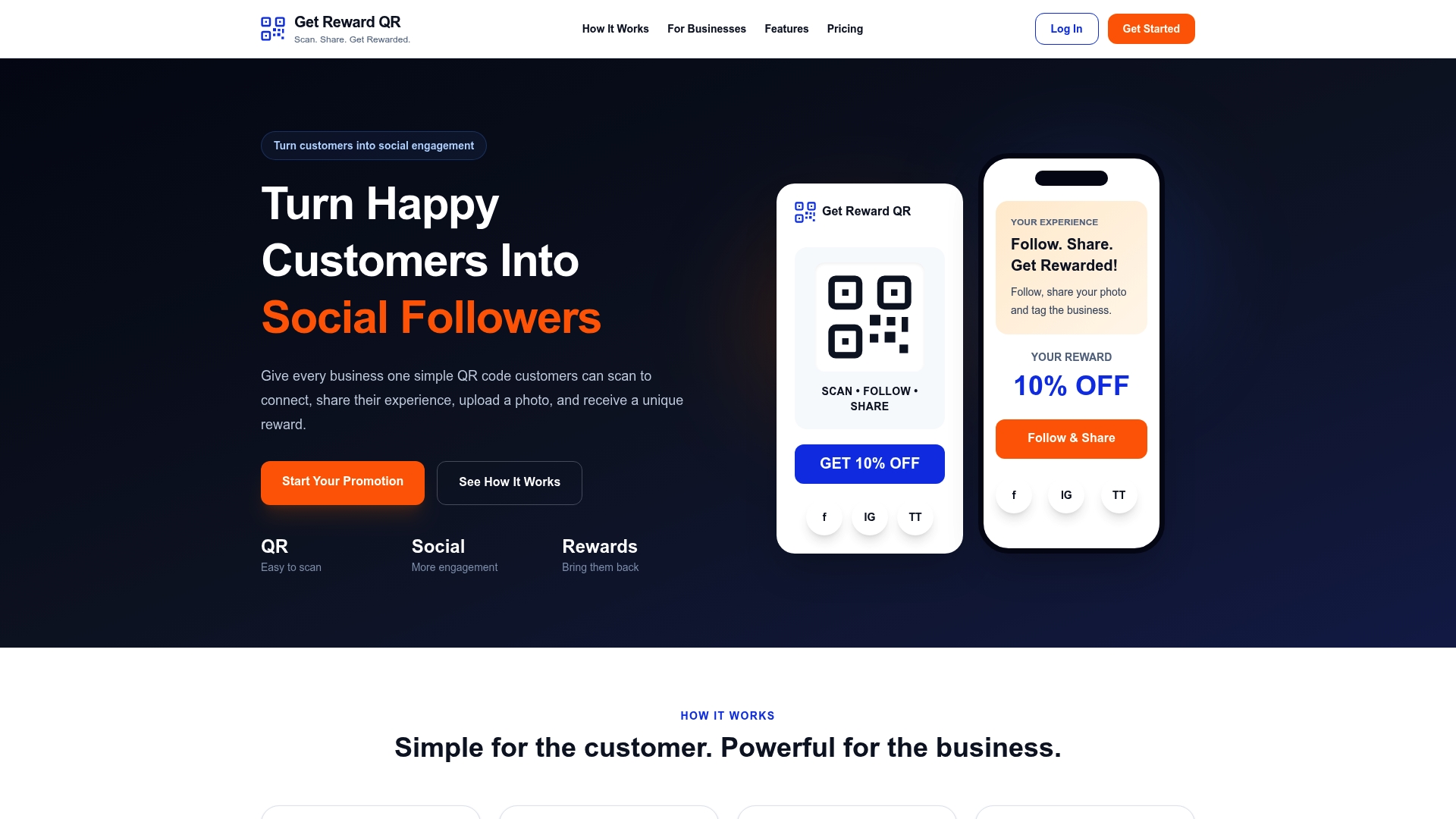
You choose the branding, the offer, and which social platforms each campaign asks for. Pair it with the 30 to 90 day pilot above and you have a measurable test of whether rewards bring your customers back. We offer a Monthly plan at 19.99 USD per month and an Annual plan at 199 USD per year, both listed on our pricing page. Start a pilot at Get Reward QR and check your repeat customer rate after the pilot.
FAQ
What is a repeat customer?
A repeat customer is someone who buys from you more than once within a period you define, such as a quarter or a year. Tracking them as a share of all customers gives you your repeat customer rate, the core retention metric for most small businesses.
How do you ask a customer for a repeat order?
Ask soon after the first purchase, and attach a small, specific reason to return, such as a coupon good on the next visit. A short post-purchase question about when they plan to buy again can also speed up the repeat, according to a Journal of Consumer Research study.
What are effective ways to ensure repeat business?
Deliver a reliable experience, fix problems quickly, and make rewards simple and immediate. A meta-analysis of loyalty programs found that well-designed programs enhance behavioral loyalty, with design and industry context shaping the results.
How do you improve customer retention?
Start by measuring your repeat customer rate and time to second purchase, then improve the post-purchase experience and add triggered follow-ups. Focus first on your most valuable customers, since retention gains compound into larger profit gains.