Test App Free QR Offers With A/B Experiments for Local Businesses
Test App Free QR Offers With A/B Experiments for Local Businesses

Delivering that offer through an app-free QR flow, paired with a Google Business Profile offer post and a visible QR at checkout, gets results faster than most other setups. The next move is simple: build the offer now with a campaign name, start and end date, and a printed QR code placed where new customers will actually see it.
TL;DR:
- Keep reward amounts aligned with the effort required, typically $5 to $10 for actions like follows or sign-ups, to ensure campaign profitability.
- Place QR codes at high-visibility, natural customer pause points such as counters, entrances, or receipts, to maximize scan rates.
- Set single-use codes with short expiry windows and staff verification to prevent abuse and ensure genuine new customer redemptions.
- Prioritize channels like Google Business Profile posts, store signage, and email capture tools for rapid and reliable offer exposure.
- Use a straightforward, app-free workflow with clear instructions and staff training to streamline the redemption process and improve results.
Table of Contents
- Designing the Offer: Reward Size, Eligibility, and Redemption Rules
- Where to Place and Promote Your Welcome Offer
- Step-by-Step: Setting Up an App-Free QR Welcome Offer With Get Reward QR
- Measuring and Optimizing Your Welcome Offer
- What Small Changes Actually Move the Needle
- How Get Reward QR Makes Welcome Offers Simple to Run
- FAQ
- Sources
- Official Docs and Research for Setup and Optimization
Designing the Offer: Reward Size, Eligibility, and Redemption Rules
Before you print a single QR code, decide on one objective. Are you chasing first purchases, sign-ups, or social follows? Each goal calls for a different reward size and a different redemption path, and mixing goals into one offer usually dilutes all three.
Reward sizing should track the effort you’re asking for. A follow or sign-up prompt typically justifies a small reward in the $5 to $10 range, since the customer’s lift is minimal. Retention research from URI’s Small Business Development Center notes that matching reward size to the action, and to the fact that acquisition costs more than retention, keeps campaigns profitable rather than just popular.
Abuse control matters just as much as reward size. Build these guardrails into every campaign:
- Generate single-use coupon codes so no customer can redeem twice.
- Capture a phone number or email at the scan step to confirm a real new customer.
- Set short expiry windows, often 7 to 14 days, to create urgency and limit stale redemptions.
- Require staff verification before honoring any coupon at checkout.
Keep the redemption flow short: QR scan, then a brief form or social step, then a single-use coupon delivered by text or email, or shown directly to staff. This structure mirrors what experiment-based research on compliance promotions recommends: randomize the hurdle and the reward size across different versions of your offer so you can see which combination actually drives profitable compliance, not just raw redemptions.
Pro Tip: Test two hurdle levels (like “follow only” vs. “follow plus a short form”) before committing to one, since a slightly higher hurdle sometimes produces better-qualified customers at a similar redemption rate.
Where to Place and Promote Your Welcome Offer
Getting the offer in front of new customers matters more than the offer’s design in the first few weeks. Prioritize channels that put the QR code directly in a customer’s path:
- Put window decals, table tents, receipt footers, and checkout signage with the QR code at every physical touchpoint a new customer passes.
- Publish a Google Business Profile offer post with a clear title, start and end dates, and let the automatic “View Offer” button do the work. Google’s own documentation confirms this button appears on Search and Maps once the post is live, and GBP best-practice guidance recommends posting regularly with clear visuals and dates to build trust.
- Extend reach with social posts, an in-store Wi-Fi redirect page, email capture at checkout, and, for retail businesses selling online, a first-order promotion in Google Shopping configured for new-customer acquisition through Merchant Center.
One compliance note matters here: never offer an incentive in exchange for a review. Google’s guidance on review links is explicit that incentivized reviews violate policy, even though QR codes and direct links for review requests are allowed on their own. Businesses that want help managing GBP optimization and review strategy without doing it in-house can work with a dedicated GBP management partner.
Before launch, run through a short checklist: visuals printed, QR codes tested, GBP offer published, and staff briefed on the redemption steps.
Step-by-Step: Setting Up an App-Free QR Welcome Offer With Get Reward QR
Running this entire flow without asking a single customer to download an app is the point. Here’s the practical workflow using Get Reward QR:
- Create a new campaign and name it clearly (for example, “First Visit 15% Off”).
- Define the step a customer must complete: a social follow, a short form, or a photo upload with a tag.
- Set the reward as a single-use coupon so each code redeems once.
- Generate the QR code and download the visual asset for print or screen.
- Place the QR where customers naturally pause: at the register, on a table tent, or at the entrance.
- Brief staff on how to verify and redeem the coupon, including using universal POS mode if you’re ringing it up directly.
- Run one test scan yourself before the campaign goes live, end to end.
Before printing anything, prepare a short line of landing text explaining the offer in one sentence, clear instructions if you’re requiring a photo or tag, and a simple procedure for staff to confirm a code hasn’t already been used.
Pro Tip: Keep the form step to one field whenever possible. Every extra field you add to the scan flow costs you a percentage of completions.
Measuring and Optimizing Your Welcome Offer
A welcome offer that drives traffic but loses money on every redemption isn’t working, even if the redemption rate looks healthy. Track these metrics from day one:
- Redemption rate: the share of QR scans that complete the full flow and claim the coupon.
- Cost per new customer: total reward cost plus any ad spend, divided by new customers acquired.
- Average order value among compliers, compared to your typical new-customer ticket.
- Repeat rate at 30 and 90 days, which tells you whether the offer attracted loyal customers or one-time discount seekers.
One of the more useful findings comes from research on compliance promotion design, which shows that randomizing reward size and hurdle across customer segments, rather than guessing at one combination, lets you estimate incremental margin against total reward cost directly, instead of optimizing for redemption volume alone.
Test one variable at a time: reward size, minimum spend hurdle, QR placement (window versus table), or form length. For segmentation, spatial and competitor-based targeting research suggests prioritizing customers geographically likely to switch from a nearby competitor, rather than blanketing your entire trade area with the same discount. Watch sample size before declaring a winner. A handful of redemptions swinging a percentage point either way isn’t a result, it’s noise, so wait for a meaningful, sustained gap before rolling a change out to every location or channel.

What Small Changes Actually Move the Needle
The biggest gain I’ve seen from a welcome offer didn’t come from raising the discount. It came from cutting the redemption form from three fields to one and moving the QR code from a back wall to the counter next to the register. Scans went up because customers simply saw the code more often, and completions went up because the ask got smaller.
Train staff on the redemption steps before launch day, not during it. A cashier who hesitates over a coupon code erodes trust fast. Place QR codes at eye level, near where customers already pause: the counter, the door, the receipt. Follow up with a short message a few days after redemption to invite a return visit.
The most common mistakes are rewards too small to notice, redemption steps nobody explained clearly, and staff who weren’t briefed before the first customer tried to redeem.
— Arturo
How Get Reward QR Makes Welcome Offers Simple to Run
Everything in this guide, the single-use coupon, the one-step social or sign-up action, the staff redemption flow, and the campaign-level tracking, runs through our platform without asking a single customer to download an app.
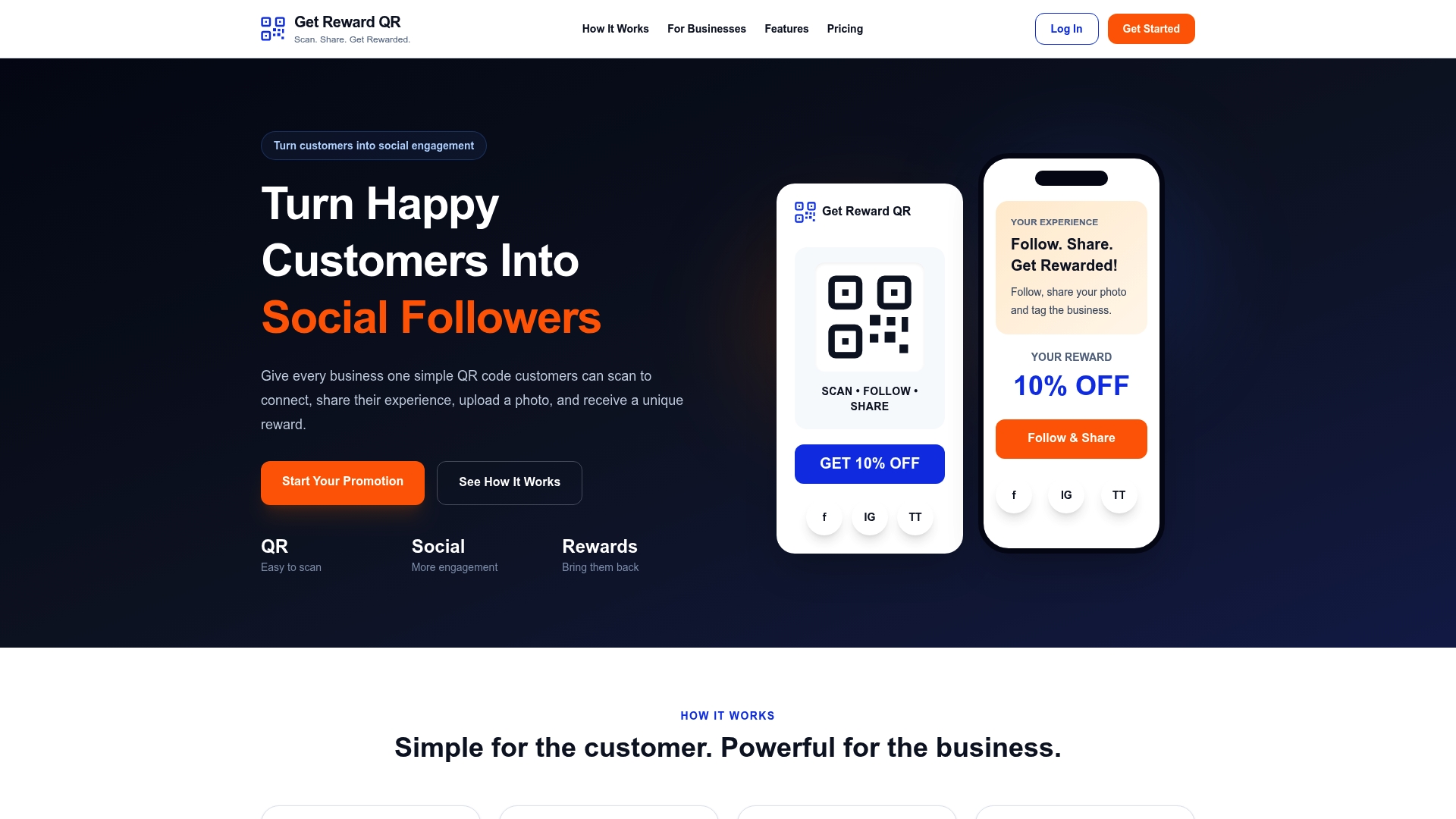
We built Get Reward QR around a QR-based, app-free flow, because local businesses like restaurants, gyms, and salons need something customers will actually use, not another app competing for space on someone’s phone. Our platform includes:
- A campaign builder for defining social-follow, form, or photo-and-tag steps.
- Single-use coupon generation to prevent repeat redemptions.
- Universal POS mode so staff can verify and redeem offers at checkout.
- Campaign analytics to track scans, completions, and redemptions over time.
Before you sign up, have your offer details ready: the reward, the one action you want customers to take, and your campaign dates. From there, you can view our pricing, which includes a Monthly plan at $19.99 per month and an Annual plan at $199 per year, or visit our home page to see the full platform in action.
FAQ
What should a welcome offer for new customers include?
A welcome offer should reward one clear action, such as a first purchase, a sign-up, or a social follow, with a single incentive tied to a QR code scan. Keep the redemption step short: a scan, one quick action, and a single-use coupon delivered by text, email, or shown to staff.
How much discount should a first-purchase welcome offer give?
A first-purchase offer commonly falls between 10% and 20% off, or a flat $10 to $20, depending on your margin, since acquiring a new customer costs more than retaining one according to retention research from URI’s SBDC. Smaller rewards in the $5 to $10 range typically suit lower-effort actions like a follow or sign-up.
Can I offer a discount in exchange for a Google review?
No. Google’s own guidance prohibits offering any incentive in exchange for a review, even though QR codes and direct links for requesting reviews are allowed on their own. Keep review requests and welcome-offer incentives as separate, unconnected actions.
Does posting a Google Business Profile offer actually help visibility?
Yes. Offer posts on Google Business Profile automatically display a “View Offer” button on Search and Maps, and GBP best-practice guidance recommends posting regularly with clear visuals and dates to build visibility and trust with new customers.
How do I prevent customers from reusing a welcome-offer coupon?
Set each coupon code to single-use, require a short form or social step to claim it, and have staff verify the code before redeeming it at checkout. Short expiry windows, often one to two weeks, also limit how long a code stays valid for reuse.
Sources
- Google Business Profile insights and local visibility (DashThis)
- Create & manage posts on your Business Profile - Google Business Profile Help
- The design and targeting of compliance promotions (Marketing Science)
- GBP Best Practices Playbook 2026
Official Docs and Research for Setup and Optimization
- The design and targeting of compliance promotions (Marketing Science)
- Google Business Profile insights and local visibility (DashThis)
- Create & manage posts on your Business Profile - Google Business Profile Help
- GBP Best Practices Playbook 2026
- Leveraging loyalty programs using competitor-based targeting (UCLA/Anderson research)
- How customer retention strategies help small businesses grow (URI RISE SBDC)
- Create & share a Google review link - Google Business Profile Help
- First-order promotions and new customer acquisition - Google Merchant Center