No App UGC Rewards for Local Shops: QR First, POS Single Use Coupons
No App UGC Rewards for Local Shops: QR First, POS Single Use Coupons

UGC rewards are an effective, low-friction way for local businesses to turn customer photos and tags into measurable visits, if you use QR codes to remove friction and reward authentic shares. A QR-driven reward system lets a customer post a photo, tag your business, or leave a review, then redeem a discount instantly, no app required. Start with a small pilot: expect more genuine social posts and a visible lift in repeat visits and redemptions within weeks.
TL;DR:
- Most consumers scan QR codes expecting detailed content, but only about a third of businesses deliver this, making a mobile-first landing page essential.
- Deep storytelling prompts, such as asking why a customer values the brand, significantly increase social sharing and content longevity.
- Implementing a simple redemptions process tied to the existing POS system and setting weekly or biweekly expiration windows reduces fraud.
- Tracking key metrics like scan volume, social shares, and redemption rates over four to eight weeks provides a clear view of campaign success.
- Launching with a focused goal, a specific call to action, and placing QR codes where customers naturally wait boosts participation and campaign effectiveness.
Table of Contents
- Why authentic UGC and QR-based rewards drive engagement
- Building the QR campaign step by step
- Picking incentives that drive participation without hurting margins
- Tracking the KPIs that tell you it’s working
- A campaign checklist worth running before launch
- How Get Reward QR fits this blueprint
- FAQ
- Sources
Why authentic UGC and QR-based rewards drive engagement
User-generated content works because it asks customers to invest something of themselves, not just tap a button. A Kellogg Insight analysis of a loyalty program’s UGC contest found that participants who wrote deeper, story-driven submissions kept using the program more than similar non-participants for four to six weeks after the contest ended. Short captions didn’t produce that effect. The lift came from asking people to explain why the brand mattered to them, not just to post a picture.
That matters for how you write your QR prompt. “Tag us for a discount” gets a quick, forgettable post. “Tell us what made today special, then tag us” gets a story, and stories travel further and stick longer.
QR codes are the delivery mechanism that makes this practical for a local business. Uniqode’s State of QR Codes 2026 report found that 75% of consumers scan codes expecting more information, yet only 36% of marketers deliver content matched to that intent, a gap most local businesses can close just by building a clean, mobile-first landing page instead of dumping scanners onto a generic homepage. The same report treats QR codes as persistent infrastructure rather than a one-time flyer gimmick: a code you place once and improve over time, not a one-off print job.
The common thread is friction. Deep engagement plus an app-free scan path is what turns a passerby into a poster and a poster into a repeat customer.

Building the QR campaign step by step
A UGC reward campaign has five moving parts: the code, the landing page, the social step, the coupon, and the redemption flow at the register. Build them in this order so nothing breaks downstream.
- Create a branded, mobile-optimized landing page. It should load instantly on any phone browser and never ask for an app download.
- Design one or two social steps, such as “follow and tag” or “upload a photo and tag us,” with a short prompt that asks for a reason, not just a snapshot.
- Generate a single-use coupon automatically once the upload or tag is confirmed, so the customer has something concrete to redeem that day.
- Build a staff redemption flow that works with your existing point-of-sale system, so front-line staff can verify and close out a coupon in seconds.
- Write a simple moderation plan and consent line covering what you’ll do with submitted photos and how you’ll handle inappropriate content.
- Run a small pilot at one location or one shift, then test variations: a different call to action, a new QR placement, or a slightly richer incentive.
Pro Tip: Put the QR code where customers are already waiting, a table tent, a receipt, a gym mirror decal, so scanning feels like the natural next step, not an interruption.
Keep the social step narrow. One clear action beats a checklist of three, because every added step loses participants before they ever see the reward.
Picking incentives that drive participation without hurting margins
The right incentive depends on your business type and your margin per visit. A café might offer a free pastry add-on with a drink purchase. A gym might offer a free guest pass or a branded item. A restaurant might offer a free appetizer or a small percentage off the check.
- Low-value incentive: a free small add-on, best for high-traffic cafes and quick-service spots where margin per visit is thin.
- Medium-value incentive: a percentage discount or a service upgrade, suited to salons and sit-down restaurants where repeat visits matter more than any single ticket.
- High-value incentive: a free session, class, or larger discount reserved for gyms and studios trying to convert a one-time visitor into a membership lead.
Rules matter as much as the reward itself. Require a real photo or a short written tag, not just a check-in, make every coupon single-use and time-limited, and have staff verify the coupon code at redemption rather than trusting a screenshot. Set an expiration window of one to two weeks so the offer creates urgency instead of sitting forgotten in someone’s camera roll.
Pro Tip: Cap redemptions per customer per month to discourage one person from gaming the same offer repeatedly.
Basic fraud controls go a long way: moderate submissions before the coupon activates, flag duplicate images across accounts, and keep your terms language short enough that a customer actually reads it at the counter.
Tracking the KPIs that tell you it’s working
A pilot only tells you something if you track the right numbers from day one. The core funnel is scans, uploads, shares, and redemptions, each step shrinking a bit from the one before it.
- Scans: how many people engage with the code at all, your top-of-funnel signal.
- Upload or tag rate: the share of scanners who complete the social step.
- Share rate: how often that content gets reposted or reshared beyond the original poster.
- Coupon redemption rate: the share of generated coupons actually used in-store, your clearest tie to revenue.
Secondary metrics worth watching include the average order value of redeemers versus non-redeemers and whether redeemers return within 30 days. Forbes reporting on a 2026 industry survey noted that 71% of consumers find QR codes at least somewhat helpful and 98% of marketers reported a positive impact from using them, but the same piece stresses that the value shows up only when you measure what happens after the scan. A four-to-eight week pilot with UTM-tagged links and POS-tagged redemptions gives you enough data to see real lift rather than noise, and lets you compare a pilot period against a normal month before deciding to expand.
A campaign checklist worth running before launch

Running dozens of these campaigns across different venue types teaches you that the ones that work share a short list of habits rather than any single clever gimmick. The businesses that see real lift treat the QR code as one part of a system, not a sticker on a door.
Before launch, check that you have: a clear goal (more tags, more reviews, more repeat visits), a single-sentence call to action, a QR placement customers will actually see, an incentive sized to your margin, a staff-friendly redemption flow tied to your POS, a basic moderation plan, and a way to measure scans against redemptions. Skip any one of these and the campaign tends to drift: codes go unscanned, or coupons pile up unredeemed because staff don’t know how to close them out.
— Arturo
How Get Reward QR fits this blueprint
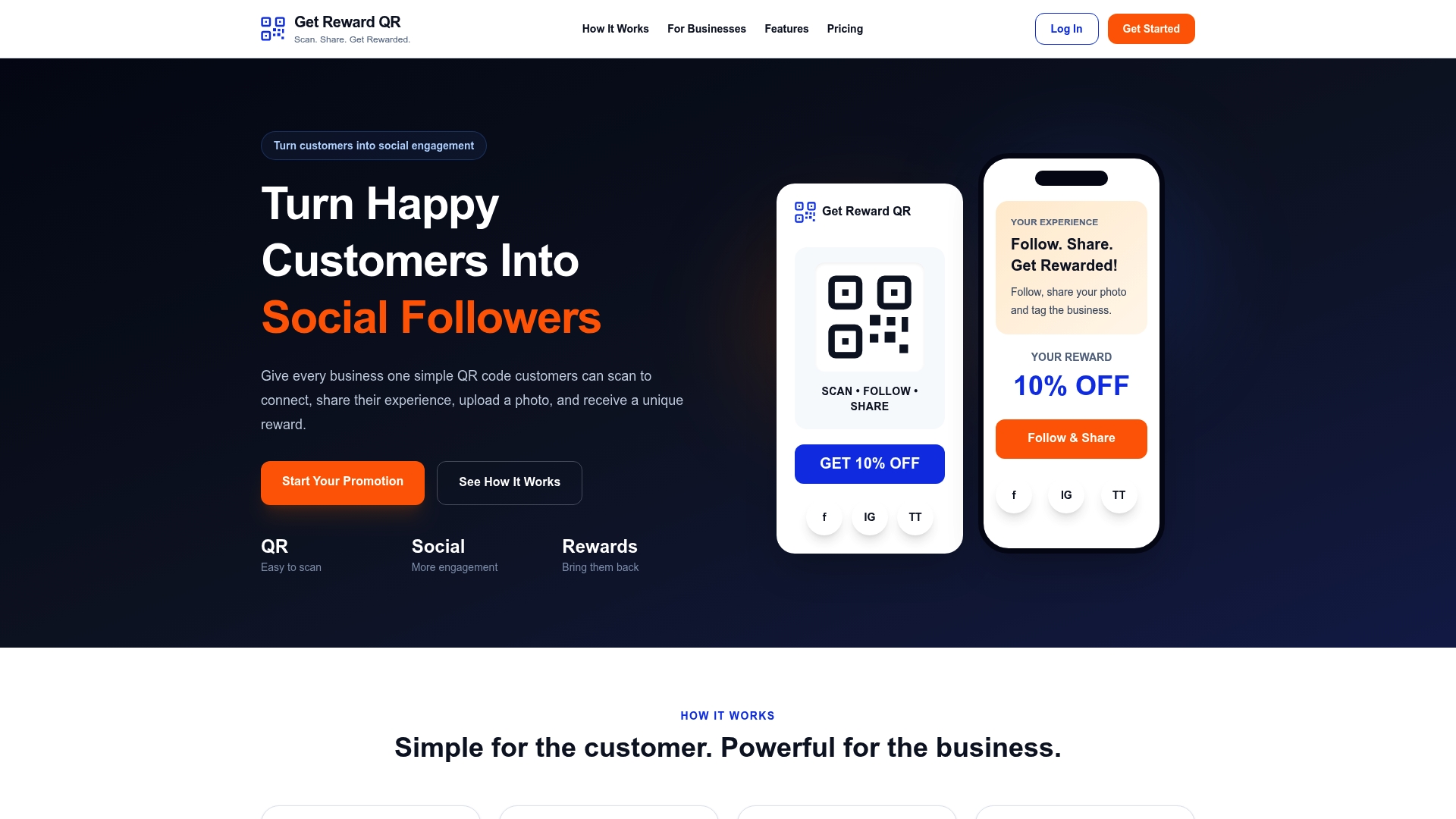
Every step in this playbook maps directly to what we built our platform to do. We give you a branded, mobile-optimized landing page that needs no app download, built-in photo upload and tagging steps, automatic single-use coupon generation, and a universal POS-compatible redemption flow your staff can run without training. Campaign analytics track scans, uploads, and redemptions in one dashboard, so you’re not stitching together spreadsheets to see what a pilot actually produced.
- Review plan details on our pricing page for current subscription pricing and options.
- Explore the full feature set on the Get Reward QR platform page.
- Pair your campaign with paid social promotion through a resource like Senior Ad Managers to amplify the UGC your customers create.
If you’re ready to turn scans into visits, start with one location and one offer, then scale what works.
FAQ
What counts as a UGC reward for a local business?
A UGC reward is a discount, free item, or coupon a business gives a customer in exchange for a photo, tag, or review shared through a QR code scan. The reward is typically delivered as a single-use coupon the customer redeems in person after completing the social step.
Do customers need to download an app to participate?
No. The strongest QR-based UGC campaigns run entirely through a mobile browser landing page, with no app download required, which is also what Uniqode’s 2026 report points to as a major driver of higher completion rates.
How long should a pilot campaign run before I judge results?
A four-to-eight week pilot gives enough scan and redemption data to compare against a normal month without the rules changing mid-test. Track scans, upload rate, and redemption rate throughout so you can spot a real pattern instead of a single busy weekend.
What does Get Reward QR cost?
Get Reward QR offers a Monthly plan at $19.99 per month and an Annual plan at $199 per year, both listed on our pricing page. Both plans include the full QR campaign toolkit, from landing pages to POS-compatible coupon redemption.
How do I stop customers from gaming a single-use coupon?
Require a real photo or written tag rather than a simple check-in, set an expiration window of one to two weeks, and have staff verify the coupon code at the register instead of accepting a screenshot. Capping redemptions per customer per month also limits repeat abuse of the same offer.