3 QR First Social Media Rewards That Turn Scans Into Store Visits
3 QR First Social Media Rewards That Turn Scans Into Store Visits

Social media rewards are incentives like discounts, coupons, points, or contest entries that motivate followers to take a specific social action: following, tagging, uploading a photo, or sharing contact details. For small businesses, the most useful version is simple: a QR-based coupon or a low-effort photo contest that drives repeat visits and real user-generated content, without needing custom app development or heavy verification staff.
TL;DR:
- Coupons and QR codes provide the best balance of low verification effort and measurable results for small business reward campaigns.
- Rewards should focus on specific, verifiable actions like coupon redemption, form completion, or photo uploads to ensure quality engagement and accurate tracking.
- A QR-based, no-app system increases participation by simplifying the process and can include analytics, staff redemption tools, and single-use coupon controls.
- Disclosing clear, conspicuous rules and focusing on actions that generate contacts is critical to comply with legal guidelines and build trust.
- Small businesses should prioritize converting social activity into owned channels through tracking coupon use, sign-ups, and repeat visits for lasting growth.
Table of Contents
- Types of social media rewards and incentives
- Why social media rewards work (benefits and behavioral levers)
- Step-by-step: design and run a social-media rewards campaign
- Legal, disclosure and trust considerations
- Measure results and move followers to owned channels
- Quick templates: three mini campaigns you can launch today
- Why a QR-based, no-app rewards flow helps small businesses
- What small businesses get wrong about social media rewards
- Get Reward QR: a practical way to run these campaigns
- Sources
- FAQ
Types of social media rewards and incentives
The reward type you pick should match how much verification effort you can afford and how long you want the payoff to last.
- Virtual points: Earned per action (follow, check-in, post) and redeemed later; easy to automate but require a system to track balances.
- Discounts and single-use coupons: A fixed percentage or dollar amount tied to one redemption, often distributed as a QR code or unique code; low fraud risk because each code works once.
- Badges or status tiers: Recognize repeat engagement without direct cost, useful for building identity around a brand but weak on driving immediate sales.
- Sweepstakes and contests: One or a few winners selected from eligible entries; cheap per entry but require clear rules and a transparent selection process.
- UGC incentives: Rewards tied to a photo, video, or tagged post, which generate content you can reuse but need someone to check that entries meet the rules.
Coupons and single-use codes tend to offer the best balance of low verification effort and measurable return, since redemption itself proves the action happened. Contests build buzz quickly but demand more oversight to keep entries honest.
Why social media rewards work (benefits and behavioral levers)
Rewards work because they tap into reciprocity (people feel inclined to act when given something of value), social proof (seeing others participate makes joining feel normal), and habit formation through repeated small payoffs. Research on social networks and customer loyalty found that incentives combined with relevant, value-adding content and quality visuals increase both loyalty and participation, while rewards built only around gamified likes or shares fall short.
That distinction matters for design. A reward tied to a vague action, like any share or comment, tends to pull in low-effort, low-quality engagement. Yale research on social media and misinformation found that reward structures favoring sharing volume can unintentionally encourage inaccurate or low-value content, while structures that reward accuracy shift habits toward higher-quality sharing, even after the reward disappears. Build your campaign around specific, verifiable actions rather than raw volume.

Step-by-step: design and run a social-media rewards campaign
A rewards campaign works best when you define the exact action you want before choosing a mechanic.
- Set the goal and target action. Decide whether you want follows, tags, photo uploads, or email sign-ups, since each goal points to a different mechanic.
- Choose your mechanics. A QR scan that unlocks a coupon works well for in-person businesses; an entry form suits sweepstakes; a hashtag with manual review suits UGC contests.
- Write clear rules and disclosures. State eligibility, start and end dates, how winners are chosen, and disclose the incentive conspicuously in the post itself.
- Plan fulfillment. Use single-use codes redeemed by staff at checkout, set an expiration date, and keep a simple log for accounting.
- Promote across channels. Post where your audience already is, pin the campaign post, and cross-promote to your email list or SMS subscribers to extend reach beyond the platform.
Pro Tip: Cap each coupon to one redemption per customer and print the code’s expiration date directly on the QR display to cut down on confusion at checkout.
Keep the rules short enough to fit in a caption, but specific enough that a customer or a regulator could read them and know exactly what qualifies.
Legal, disclosure and trust considerations
The FTC’s Endorsement Guides require clear, conspicuous disclosure whenever an incentive could affect how credible a post or review appears, and recommend using plain language like “contest” or “sweepstakes” directly in the post or hashtag rather than relying on a platform’s built-in like or tag feature as the only signal. Avoid paying for fake followers, reviews, or engagement; require real interactions and say plainly that a reward was given. Where possible, structure the reward around a verifiable step, such as a coupon redemption or a completed form, rather than a generic like or comment, since that keeps both your records and your disclosures accurate.
Measure results and move followers to owned channels
Engagement numbers on a platform you do not own can disappear overnight if an algorithm changes, so the real goal is converting social activity into contacts you control.
- Track subscriber capture rate: the share of campaign participants who also join your email or SMS list.
- Track coupon redemption rate: how many issued codes actually get used in-store.
- Track repeat visit rate: whether reward recipients come back within a set window.
- Watch UGC submission quality: whether uploaded photos or tags meet your campaign’s actual requirements.
Practical capture tactics include a sign-up link in your bio, a QR code leading to a short opt-in form, an SMS keyword, or an email field during coupon redemption. Guidance on social media loyalty programs recommends feeding these loyalty events directly into email or SMS automation, so a redeemed coupon or earned point can trigger a personalized follow-up offer automatically.
Quick templates: three mini campaigns you can launch today
Each of these can run with minimal setup and no custom development.
- Photo-tag UGC contest: Ask customers to post a photo with your product, tag your account, and use a campaign hashtag; verify manually, then reward the best entries with a discount and feature winners in your next post.
- Scan and save QR coupon: Place a QR code on tables, receipts, or windows; scanning generates a single-use code redeemed at the register through your point-of-sale system.
- Follow and earn micro-loyalty: Award a point for following plus a point per visit, set an expiration window, and let accumulated points convert into an emailed discount code once a threshold is reached.
Why a QR-based, no-app rewards flow helps small businesses
A QR code that leads straight to a social follow, a photo upload, or a coupon removes the biggest barrier to participation: asking someone to download an app for a one-time reward. Customers scan, complete a short step, and claim a reward in under a minute, which raises completion rates compared to multi-screen sign-up flows.

For a local business running this kind of campaign, prioritize a few specific features: single-use coupon generation to prevent repeat redemption, photo upload support for UGC campaigns, staff-side redemption tools that work at any point-of-sale setup, and basic campaign analytics to see which offers actually convert. QR-based reward systems are built around exactly this no-app structure for local businesses like restaurants, gyms, and salons.
What small businesses get wrong about social media rewards
Most advice on this topic treats engagement as the finish line, when it is really the starting line. A business that collects likes and tags but never routes those people into an email list or a redemption record has traded effort for a number that an algorithm change can erase tomorrow. The conventional playbook, built for brands with marketing teams and dedicated community managers, overstates the value of big sweepstakes and understates the value of small, repeatable mechanics: a coupon, a tag, a scan.
What the evidence actually supports is narrower and more useful for a small operation: reward specific, verifiable actions, keep disclosures plain, and build every campaign so the reward itself (a redeemed coupon, a completed form) also captures a contact you can message later. Skip the contest with vague rules and uncertain winners. Start with the mechanic that pays for itself in a single visit, then expand once you can see which one actually brings people back.
— Arturo
Get Reward QR: a practical way to run these campaigns
There are QR-based rewards systems that run without a customer-facing app, allowing customers to scan, follow or share, and receive a reward tied to the business’s own rules.
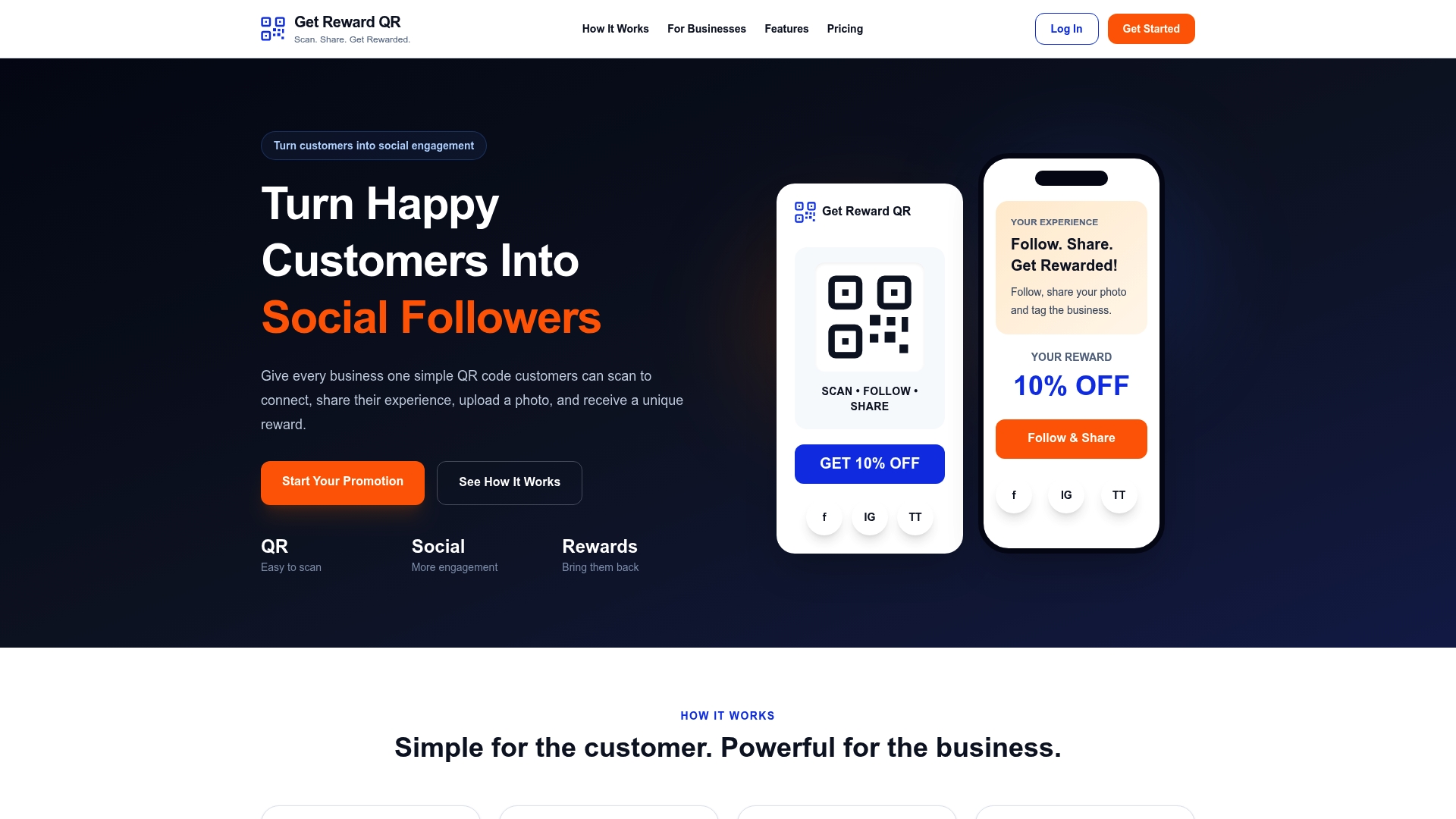
- Low friction: Customers complete the scan-and-follow flow without downloading anything.
- Built-in analytics: Campaign dashboards can show which offers and actions convert.
- POS-friendly redemption: Staff can redeem single-use coupons through a point-of-sale system.
Compare that to running a sweepstakes by hand with a spreadsheet and a hashtag search: the mechanics described earlier in this guide (single-use coupons, photo uploads, staff redemption) come built in. Check pricing for the Monthly and Annual plans to see which fits your business.
Sources
This guide draws on peer-reviewed research linking incentives to customer loyalty, Yale research on reward design and misinformation, FTC endorsement guidance, and Klaviyo’s guidance on moving social followers to owned channels. For campaign promotion tactics, see Blistr’s marketing technology resources and Trinity Brotha Israel’s marketing package examples.
- Social networks and customer loyalty: review of loyalty keys and main social networks publications’ characteristics
- How social media rewards misinformation
- FTC’s Endorsement Guides: What People Are Asking
- Social Media Loyalty Program: Win Loyal, Repeat Buyers - Klaviyo
FAQ
Is the Media Rewards app real or fake?
Media Rewards is a real market research panel where people earn rewards by sharing media exposure data rather than by posting on social platforms. User reviews are mixed, with some reporting trouble winning prize draws despite a high overall rating.
What is the best app for earning rewards?
There is no single best app since reward apps vary by type: some pay for market research participation, others for loyalty check-ins or referrals. The right choice depends on whether you want cash-style payouts, discounts, or points redeemable with a specific business.
What are some other apps similar to Media Rewards?
Other apps in this space generally fall into market-research panels, survey reward platforms, or retailer-specific loyalty apps, each trading personal data or attention for points or cash. None are evaluated in this guide beyond Media Rewards itself.
What apps do rewards?
Rewards come through several app types: market-research panels, retailer loyalty apps, cashback apps, and QR-based coupon systems that skip the app download entirely. The right fit depends on whether you’re earning as a consumer or running a program as a business.