3 App-Free Coffee Shop Loyalty Templates for Indie Cafes
3 App-Free Coffee Shop Loyalty Templates for Indie Cafes

The single best priority for coffee shop loyalty is simplicity: low friction enrollment through a QR scan or a phone number at the register, paired with small, frequent rewards. Physical punch cards get lost or forgotten, which quietly kills participation before a program has a chance to work. A frictionless setup makes it easy to capture customer data and nudge people back through the door more often.
TL;DR:
- Using a QR code for enrollment enables immediate, frictionless sign-up and reduces forgetfulness that often causes physical punch card failure.
- A simple stamp card system typically requires only a brief staff explanation and caps rewards to maintain profit margins.
- Points programs incentivize larger purchases but require several visits to reach initial rewards, making them better for retail alongside drinks.
- Membership models suit cafes with predictable daily traffic, offering immediate value and recurring revenue through flat fees.
- App-free QR loyalty systems are highly effective for small cafes since they eliminate barriers like app downloads and account management, boosting participation.
Table of Contents
- Three loyalty program templates you can copy today
- Which loyalty program type fits your café, and how customers join
- How to design reward economics that protect your margin
- What to measure to know if your program is working
- A step-by-step launch checklist for your first 6 to 8 weeks
- Why app-free QR loyalty tends to win for small, independent cafes
- What independent café owners usually get wrong
- A discreet alternative: how Get Reward QR solves the app-download problem
- FAQ
- Sources
Three loyalty program templates you can copy today
Most successful coffee shop loyalty programs borrow from one of three simple structures. None of them need custom software or a long rollout, and each fits a different kind of café.
Template A: the digital stamp replacement. This is the closest thing to a punch card, just without the paper. A customer scans a QR code at checkout, a stamp gets added to their account, and after a set number of visits they get a free drink. A common pattern is “buy 8, get the 9th free,” since it mirrors what most customers already expect from a traditional card. The message at signup can be as short as: “Scan here, collect stamps, your 9th coffee is on us.” Time to value is immediate: the first stamp lands on the first visit, and most regulars notice the pattern within two or three weeks. This template fits cafés with a simple menu and high repeat traffic, like a neighborhood shop near offices or a university building, which matters given how often physical loyalty cards go unused on campus.
Template B: points that unlock tiered rewards. Instead of one fixed reward, customers earn points per dollar spent, say one point per dollar, and can redeem at different thresholds: 50 points for a pastry, 150 points for a specialty drink, 300 points for a bag of beans. This rewards bigger baskets, not just visit count, so it works well for cafés that sell retail items or food alongside drinks. A simple launch message might read: “Every dollar earns a point. Redeem starting at 50 points, no expiration for 90 days.” This structure takes a bit longer to feel rewarding since customers need a few visits to reach the first threshold, usually three to five, but it tends to lift average order value because customers add an extra item to cross a point milestone.

Template C: a weekly or monthly membership pass. Customers pay a flat fee upfront, for example $25 a month, and get a daily drip coffee free or discounted drinks on every visit. This fits cafés with predictable foot traffic and a strong daily routine customer base, like a coffee shop near a train station or a coworking space. The pitch here is simple: “Pay once, drink all month.” Value is felt immediately since the first free coffee often pays back a third of the membership cost, and the model gives owners predictable recurring revenue instead of waiting on organic repeat visits.
A few mechanics apply across all three templates:
- Keep the earn rule to one sentence so staff can explain it without a script.
- Cap the reward at a cost you have already modeled against your margin.
- Set an expiration window on points or stamps, typically 60 to 90 days, to keep the program active rather than dormant.
Each template solves a different problem: Template A is about habit formation, Template B is about basket size, and Template C is about locking in recurring revenue. Picking one over the others usually comes down to your typical customer visit pattern rather than preference.
Which loyalty program type fits your café, and how customers join
Coffee shop loyalty programs generally fall into five types: stamp or punch based, points based, visit based (reward tied purely to visit count, not spend), membership or subscription based, and experience based (perks like early access to seasonal drinks or invitations to tasting events rather than discounts). Stamp and visit based programs are the easiest for customers to understand and the easiest for staff to run, which makes them the right starting point for most independent shops. Points based programs reward spend rather than frequency, so they fit cafés that also sell food or retail goods. Membership programs suit high-frequency locations with predictable daily traffic. Experience based programs work best layered on top of one of the others, since research on Gen Z coffee loyalty found that brand attachment and experiential moments both strengthen loyalty, and a strong brand image makes those experiential touches resonate more.
How customers join matters as much as the reward structure. There are three common signup methods:
- QR code scan: the customer scans a code at the counter or on a table tent, which opens a lightweight profile with no download required.
- POS-linked phone number: staff ask for a phone number at checkout, and the POS system tracks visits or points against that number automatically.
- Branded app: the customer downloads a dedicated app, creates a login, and manages their account inside it.
Apps offer more customization, things like push notifications and in-app ordering, but they also demand a download, an account creation step, and ongoing maintenance that most independent shops are not staffed to handle.
Pro Tip: If you are choosing between app and app-free, default to app-free QR or POS-linked signup unless you have the staff to manage app updates, customer support tickets, and app store reviews.
How to design reward economics that protect your margin
Reward design is really a math problem dressed up as a marketing decision. Before picking an earn rate, run the numbers so a loyalty program adds visits without quietly eating your margin.
- Calculate your cost per reward. If a free drink costs you $1.20 in ingredients and the program gives one away every 9th visit, your cost per loyalty visit is $1.20 divided across 9 visits, or about $0.13 per visit in reward cost.
- Estimate your break-even frequency. If a regular customer currently visits 2 times a week and the program needs to lift that to 2.3 visits a week to cover the reward cost through added revenue, you need roughly a 15% frequency increase to break even, a realistic target for a well-communicated program.
- Model your earn pattern against margin, not just revenue. A “buy 8, get the 9th free” stamp card gives away roughly 11% of volume at full cost; a points program redeemable only on lower-margin items (pastries instead of specialty drinks) protects margin better than letting points apply to anything on the menu.
- Control stacking and abuse. Limit one reward redemption per visit, issue single-use coupon codes that expire after one scan, and require staff to manually confirm redemption at the register rather than letting customers self-apply a discount.
- Set an offer cadence, not a constant discount. Frequent small nudges, a $1 off midweek coffee or a free pastry upgrade, work better than one large recurring discount because they create reasons to return on specific days rather than training customers to expect a permanent price cut.
Breakage, the share of rewards earned but never redeemed, also works in your favor. Most loyalty programs see a meaningful portion of earned rewards go unclaimed, which softens the real cost of generous earn rates. That said, do not design a program assuming breakage will bail out an unsustainable reward structure. Price the reward as if every customer will redeem it, then treat breakage as a margin cushion rather than a planning assumption.
What to measure to know if your program is working
A loyalty program is only worth running if you can see its effect on real numbers. Track a small set of metrics rather than drowning in dashboards.
- Retention at 30, 60, and 90 days: the share of enrolled customers who return within each window, which tells you whether the program is building a habit or a one-time novelty.
- Visit frequency: average visits per customer per month, compared between enrolled and non-enrolled customers.
- Average order value (AOV): whether enrolled customers spend more per visit, which matters most for points based programs.
- Redemption rate: the share of earned rewards actually claimed, which tells you if your reward threshold is realistic.
- Incremental revenue and lifetime value (LTV) uplift: the revenue difference between enrolled and unenrolled customers over a comparable period.
Running a short pilot before a full rollout keeps risk low. A 6 to 8 week test window works well for most small shops: enroll customers in two week blocks and compare their visit frequency against a control group that has not yet joined, or split by alternating days of the week if your customer base overlaps heavily. EY’s 2025 loyalty market study suggests this kind of cohort comparison is a practical way for smaller operators to size a pilot without needing a large customer base, since even a few hundred enrolled customers over six weeks produces a readable signal for visit frequency and AOV.
Once you have results, the next steps are usually small adjustments rather than a full redesign: tighten or loosen the earn rate if redemption is too slow or too fast, shift reward cadence to different days if visit data shows weak spots, or segment communications so high-frequency customers get different messages than occasional visitors.
A step-by-step launch checklist for your first 6 to 8 weeks
A loyalty program launch goes smoothly when it is treated as a small project with a clear timeline, not an afterthought bolted onto a slow week.
- Weeks 1 to 2, pre-launch setup: define your objective (more frequency, bigger baskets, or steady membership revenue), pick one template from the three above, and set up tracking through your POS or a QR-based system.
- Week 2, prepare materials: write a one-sentence explanation of the program for staff to recite, print small table tents or counter signage, and prepare two or three short promotional messages for email, text, or social media.
- Week 3, staff training: run a 15 minute training session covering how to enroll a customer, how to redeem a reward, and how to handle edge cases like a forgotten account or a disputed stamp count.
- Week 3, launch: start enrolling customers at the register with a short verbal prompt, send the first promotional message, and have a staff member spot-check the system daily for scan or enrollment errors.
- Weeks 4 to 8, monitor and adjust: track daily redemption and enrollment numbers, fix any friction points staff report, and run your first full review at the six week mark using the retention and AOV metrics above.
Pro Tip: Ask one staff member each shift to flag any moment a customer struggled to enroll or redeem. Those small friction reports are usually the fastest way to spot a broken step before it costs you participation.
Post-launch, treat the first review as a working session rather than a verdict. Collect feedback from both staff and customers, check which reward threshold felt too far away, and adjust messaging cadence before committing to a longer-term version of the program.
Why app-free QR loyalty tends to win for small, independent cafes
The biggest obstacle to loyalty program participation is not reward design, it is the friction of carrying or installing something. That single data point explains why so many independent café loyalty programs quietly fade out within a few months: the card itself becomes the barrier.
QR-based, app-free enrollment removes that barrier because there is nothing to carry and nothing to install. A customer’s phone is already in their hand at checkout, so a scan takes seconds and creates a lightweight profile tied to that phone rather than a physical object that can be left at home. This lines up with broader industry findings: EY’s 2025 loyalty market study found that mobile accessibility and timely alerts are central to how customers want to engage with loyalty programs, while the Antavo Global Customer Loyalty Report 2025 found that a meaningful share of consumers still prefer digital loyalty cards over full app downloads, suggesting app-free digital formats sit in a sweet spot many customers already accept.
For a small café, this matters operationally as much as it matters to customers:
- No app store listing to maintain, no update cycles, and no customer support tickets about login issues.
- A QR flow can launch in a single afternoon rather than a multi-week development cycle.
- Staff only need to learn one action, scan and confirm, rather than troubleshooting an app across different phone models.
None of this replaces good coffee or good service. It simply removes the one mechanical failure point, a lost or forgotten card, that research consistently points to as the quiet reason loyalty programs underperform.
What independent café owners usually get wrong
The most common mistake is not the reward structure, it is overcomplicating the signup step. A café I’ve seen described secondhand tried a points system requiring an app download, a profile with five fields, and a separate loyalty card as backup. Enrollment stalled because staff could not explain the system in under thirty seconds, and customers abandoned the process mid-signup during a busy morning rush.

Three lessons show up again and again. First, staff friction kills adoption faster than any reward flaw, so train staff on one sentence they can say without hesitation. Second, overcomplication is the enemy of participation, a program with three rules will always outperform one with seven. Third, poor communication wastes a good program, customers forget they are enrolled if they never hear from you again after signup.
A simple QR scan tied to a single stamp rule tends to outperform a more elaborate points and tiers system precisely because it asks less of the customer and less of the staff running it at the counter.
— Arturo
A discreet alternative: how Get Reward QR solves the app-download problem
If the friction of physical cards or app downloads is the part of loyalty you want to skip entirely, we built Get Reward QR around exactly that gap. Customers scan a code at your counter, follow a short social step, and receive a single-use coupon they redeem on their next visit, all without creating an account or installing anything.
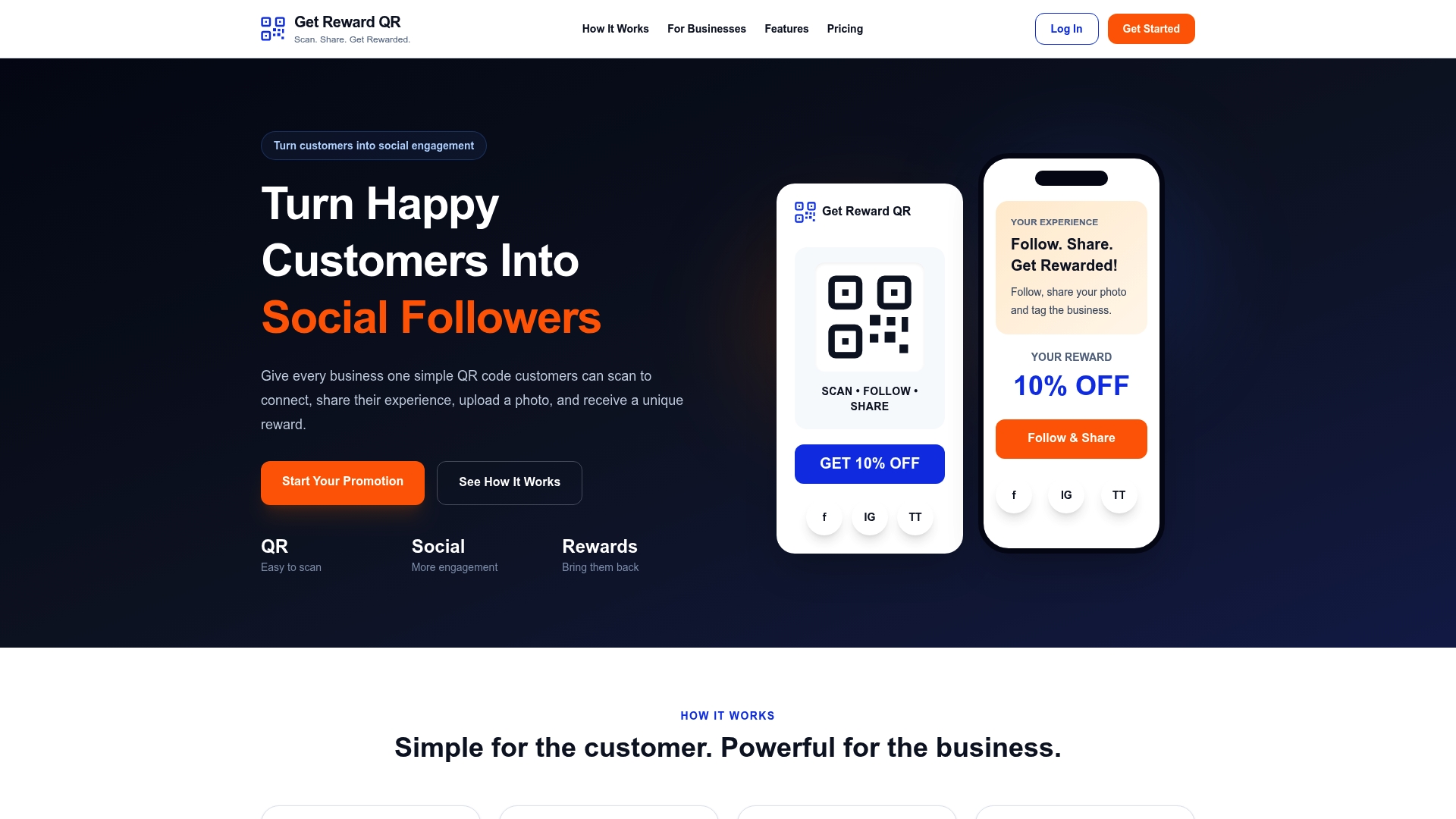
Our platform runs on universal POS mode, so it works alongside whatever checkout system you already use, and provides campaign analytics to help track enrollment and redemption. We designed it for independent, local businesses that want the engagement benefit of a loyalty program without the cost of custom development or the upkeep of a branded app.
If any of the templates above sound like something you would rather launch in an afternoon than build from scratch, check our pricing for the Monthly and Annual plans and see which fits your shop.
FAQ
What is a good loyalty app for coffee shops?
The best fit depends on whether you want a full branded app or an app-free option. Many independent cafés choose app-free QR based systems instead of a dedicated app, since they avoid downloads while still tracking enrollment, stamps, or points through a quick scan at checkout.
What are the best loyalty programs for coffee shops?
The strongest programs for small cafés are usually simple stamp or punch style rewards, points tied to spend, or a flat-fee membership for high-frequency locations. The right choice depends on whether your goal is repeat visits, bigger baskets, or predictable recurring revenue.
What are the top 10 loyalty programs?
There is no single agreed-upon top ten list for coffee shop loyalty programs, since program design varies widely by business size and goals. A more useful approach is comparing program types, stamp based, points based, membership based, and experience based, and picking the structure that matches your customer visit pattern.
What are the three types of customer loyalty?
Customer loyalty is often described in terms of behavioral loyalty (repeat purchases driven by habit or convenience), attitudinal loyalty (an emotional preference for a brand), and a blended loyalty that combines both. Research on Gen Z coffee loyalty found that experiential marketing and brand attachment both strengthen this emotional, attitudinal side of loyalty.
Why do app-free QR loyalty programs work well for small cafés?
App-free QR programs remove the biggest participation barrier, which is forgetting or losing a physical card or account login.