QR Social Media Rewards for Small Businesses: No App, 7–14 Day Pilot
QR Social Media Rewards for Small Businesses: No App, 7–14 Day Pilot

QR social media rewards are one of the most practical ways for a small business to turn a quick scan into a social follow, a tagged photo, and a return visit, without asking anyone to download an app. They work because the barrier to entry is low: a customer scans, follows or tags, and claims a reward in under a minute. Businesses that want to trial the format can start with a simple, app-free setup.
TL;DR:
- A 2025 field study tied social sharing to higher purchase frequency and spending; newsletter signups and reviews showed no comparable lift, while wish lists reduced both.
- QR links that lead directly to one task often convert faster than social hubs, and dynamic codes let businesses change offers without reprinting signs.
- Track scans, completed claims, redemptions, visits, and average spend; compare the two to four weeks before launch and measure for at least 30 days.
- Rewarded posts need clear disclosure in the caption or image, and staff should verify it before redeeming coupons; fake followers or engagement are deceptive.
- Businesses with steady foot traffic can test one location for 7 to 14 days; shops with thin traffic should address that before launching.
Table of Contents
- How QR social media rewards work: the customer flow
- Benefits for small businesses: what you can expect
- Key features to require in a QR social reward system
- Step-by-step: launch a QR rewards pilot in 7 to 14 days
- Measure success: KPIs, dashboards, and common traps
- Legal and disclosure musts when incentivizing posts
- Why app-free QR rewards fit local businesses
- Author perspective: quick decision checklist
- Try Get Reward QR for your next pilot
- FAQ
- Sources
How QR social media rewards work: the customer flow
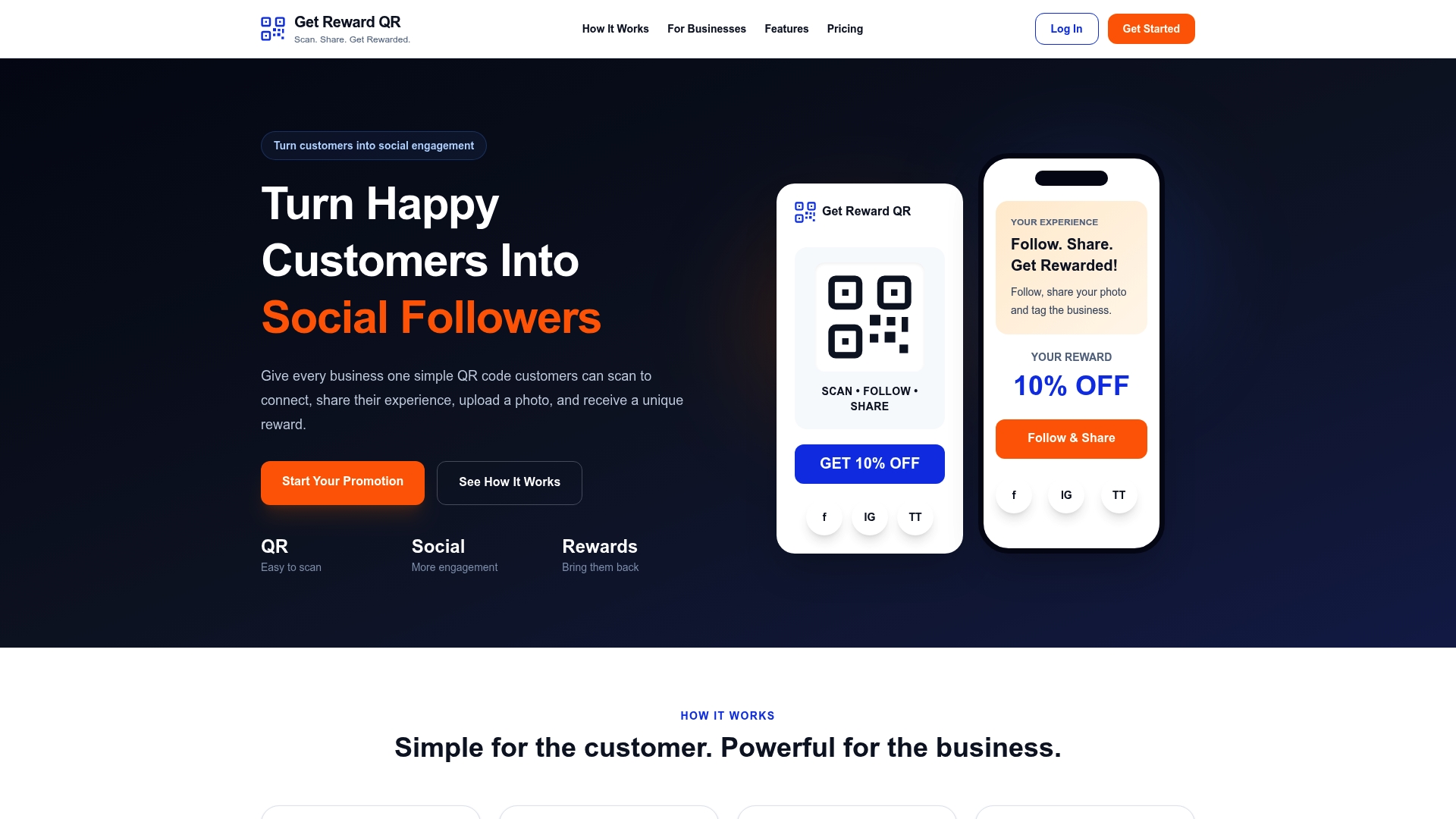
The flow is simple on purpose. A customer scans a code on a table tent, receipt, or window decal, lands on a page that asks for one social action (follow, tag a post, or upload a photo), and then claims a reward once that action is verified.
Verification is where campaigns differ. Some systems capture the follow or tag automatically through a tracked URL. Others ask the customer to upload a photo of their post, which staff or software checks against campaign rules, sometimes with timestamp or location metadata attached for extra confidence. For edge cases, a manual staff override keeps the line moving instead of stalling a customer at the counter.
There are two common layout choices. A single social hub landing page lets one QR code route to several platforms (Instagram, TikTok, Google reviews), while task-specific QR links send the customer straight to one action, which tends to convert faster because there is no extra decision to make. Static codes are cheaper and fine for fixed offers; dynamic codes let you swap the destination or reward without reprinting signage, which matters once you start testing different offers.

Benefits for small businesses: what you can expect
The core value is behavioral, not just promotional. A 2025 field study found that social sharing, meaning customers liking or sharing content, had a positive, statistically significant effect on both purchase frequency and total amount spent per customer. Other engagement actions, like newsletter signups or review writing, did not show the same lift, and adding items to a wish list actually reduced both frequency and spend. That distinction matters when you decide which action to reward.

Social sharing drives measurable spending increases, with a positive, significant effect reported in the 2025 field study. That is a meaningful signal that the social action itself, not just the discount, changes buying behavior.
Beyond spend, app-free flows cut friction compared with app-based loyalty programs, since there is no download step to lose customers at. Tagged photos and reposts also extend organic reach past your own follower count, which is free discovery you would otherwise pay for. On the operational side, single-use coupons prevent one photo or one code from being screenshotted and reused across a dozen visits, and a POS-friendly redemption step keeps staff training light.
Key features to require in a QR social reward system
Whether you build this in-house or choose a vendor, a few features separate a system that scales from one that creates headaches at the register.
- Verification that combines automated URL capture, photo upload with metadata, and a manual override for staff.
- Single-use coupon generation with a POS redemption flow, so a code can only be marked redeemed once.
- Customizable rewards and tiers, letting you choose between an instant discount and a points-based structure.
- Campaign branding controls, so the landing page and reward terms match your storefront, not a generic template.
- Analytics covering scans, claims, redemptions, and new followers you can attribute directly to the campaign.
- A visible plain-text URL fallback and a staff-assisted option for customers who cannot or prefer not to scan, which also supports accessibility best practice.
Pro Tip: Print the destination URL in small text under the QR code with a line like “Can’t scan? Ask staff,” so no customer is excluded from the offer.
Our guide to UGC verification and POS redemption walks through how these pieces fit together for shops that rely on tagged photos rather than follows.
Step-by-step: launch a QR rewards pilot in 7 to 14 days
A short pilot tells you more than weeks of guessing. Here is a sequence that fits inside two weeks for a single location.
- Pick one measurable objective, such as 50 new tagged posts or 100 new followers, and choose the single social action you will reward.
- Set the reward value and redemption rule, usually a single-use code tied to a minimum purchase if you want to protect margin.
- Design the landing flow, deciding between a single social hub or a direct link to one platform, then build printable signage for the counter, tables, or window.
- Configure verification (automated capture, photo upload, or both) and train staff on the POS step that marks a code redeemed.
- Run the pilot at one location, track scans and claims daily, and adjust the offer or signage placement if scan rates lag.
Our one-week app-free pilot walkthrough covers signage placement and reward sizing in more depth if you want a template to start from.
Measure success: KPIs, dashboards, and common traps
Five numbers tell you whether a pilot is working: scans, claim rate (scans that convert to a completed social action), redemption rate (claims that turn into an in-store reward use), incremental visits, and the change in average spend per visit.
- Compare purchase frequency for the two to four weeks before launch against the same window during the pilot to estimate real lift.
- Watch for reward-waiting behavior, where customers delay a purchase to time it with the promotion rather than visiting more often; a 2025 gamification study found that achievement and social-interaction features mediate engagement and loyalty, but short bursts of activity do not always mean lasting retention.
- Use a measurement window long enough to separate a one-time spike from a real behavior change, generally at least 30 days.
- Review the numbers weekly during the pilot and monthly after launch, using a simple dashboard with four columns: scans, claims, redemptions, and spend change.
A 2025 gamification study found that achievement systems and social interaction features significantly mediate brand engagement and loyalty. That supports rewarding the social action itself, not just offering a discount with no social step attached, as detailed in the MDPI gamification research.
Legal and disclosure musts when incentivizing posts
A tagged post or repost made in exchange for a reward is an endorsement under FTC guidance, and the rules require clear, conspicuous disclosure from the customer making the post.
- Require a short disclosure line in the caption or image overlay, such as “Rewarded post: I received a discount from [business name].”
- Never buy followers or fake engagement to inflate campaign numbers; regulators treat fake indicators of influence as a deceptive practice.
- Build the disclosure requirement into your reward terms so staff can check for it before marking a coupon redeemed.
- Train staff with a one-page script and run a monthly audit of a sample of tagged posts to confirm disclosures are present.
Why app-free QR rewards fit local businesses
Local businesses like restaurants, gyms, and salons tend to see faster adoption with flows that skip the app store entirely, using NFC cards, bracelets, and tags for digital business cards and event check-ins. Some platforms support app-free social rewards, photo upload for user-generated content, single-use POS coupons, and campaign analytics built around scans, claims, and redemptions.
- A 7 to 14 day app-free pilot with baseline metrics is usually enough to validate scan-to-store conversion before a wider rollout.
- A useful case study tracks one objective, the KPIs collected, a result snapshot, and one lesson to carry into the next campaign.
- Our campaign template examples show how other small businesses structured their first reward offer.
- Businesses running TikTok-specific campaigns can adapt the same framework, as outlined in our TikTok rewards program guide.
Author perspective: quick decision checklist
If you already have steady foot traffic, launch now with a narrow single-location pilot rather than waiting for a perfect campaign. If traffic is thin, fix that first, since no QR flow fixes an empty storefront.
— Arturo
Try Get Reward QR for your next pilot
This service runs entirely through QR codes, so customers connect with your social profiles, upload tagged photos, and claim single-use coupons without installing anything. Campaign branding, universal POS redemption, and built-in analytics stay under your control from the first scan.
- Pick one reward and one social action for your first campaign.
- Print signage with a visible fallback URL for customers who cannot scan.
- Assign one staff member to handle POS redemption during the pilot.
Our Monthly plan runs $19.99 per month and the Annual plan runs $199 per year, both covering the full app-free rewards setup described above. Start a pilot by visiting Get Reward QR and picking the plan that matches your trial length.
FAQ
How to earn money with QR code?
A QR code itself does not generate income directly; it works as a trigger for an action, such as a social follow or purchase, that produces a result for a business. Local businesses use QR social rewards to convert follows and tagged photos into repeat visits and higher spend, as shown in a 2025 field study on social sharing.
What is the FBI warning about QR codes?
Consumer protection agencies, including the FTC, have warned that scammers sometimes hide harmful links inside QR codes to steal personal information. Businesses can protect customers by printing the destination URL in plain text next to the code so anyone can verify where it leads before scanning.
Can I create a single QR code for all my social media links?
Yes, a single social hub landing page can route to multiple platforms like Instagram, TikTok, and Google reviews from one code. Task-specific links to a single platform often convert faster, since the customer has one clear action instead of a menu of choices.
How to claim QR code rewards?
A customer typically scans the code, completes one social action such as following or tagging a photo, and the system verifies that action automatically or through a quick staff check. Once verified, the customer receives a single-use coupon or discount that staff mark as redeemed at the point of sale.
Sources
- International Journal of Marketing (2025) field study on engagement actions and spending
- How gamification features drive brand loyalty: MDPI (2025)
- Guides concerning the use of endorsements and testimonials in advertising — Federal Register (2023)