Loyalty Program Compliance for Managers: Consent First, QR Ready
Loyalty Program Compliance for Managers: Consent First, QR Ready

A compliant loyalty program needs privacy-first consent, eligibility rules you can defend with evidence, marketing that matches your fine print, secure handling of customer data, and records that prove all of it happened. Regulators including the CFPB and bodies applying GDPR consent standards now treat loyalty mechanics as consumer protection matters, not marketing details. If you manage a program, start with a consent and eligibility audit this quarter, and a scan-first platform like Get Reward QR can simplify how you capture and log that consent.
TL;DR:
- Privacy compliance requires separate, informed consent for data processing and marketing, with logs stored as structured data for auditability.
- Eligibility rules must be precise, reproducible, and include fraud mitigation measures like device fingerprinting and manual review thresholds.
- Marketers must ensure disclosures are prominent and transparent, clearly stating eligibility and forfeiture conditions before customer signup.
- When working with third-party partners, building reconciliation and defined remedy processes reduces redemption failure risks and supports audit proofing.
- Maintaining ongoing compliance involves regular audits of consent, eligibility, and marketing content, with simulations like tabletop exercises to identify gaps proactively.
Table of Contents
- Data protection and consent architecture for loyalty programs
- Rewards eligibility, anti-fraud controls, and auditability
- Marketing, disclosures, and avoiding the deceptive door-opener problem
- Technical security and vendor responsibilities across deployment models
- Third-party integration risk: merchant partners, redemption partners, and fallback plans
- Compliance documentation, audit readiness, timelines, and cost drivers
- Consumer rights and how to handle loyalty program complaints
- Handling loyalty programs across multiple countries
- Compliance as a design choice, not a retrofit
- How Get Reward QR fits into a compliant rewards program
- FAQ
- Sources
Data protection and consent architecture for loyalty programs
Consent is the foundation everything else sits on, and most programs get the foundation wrong before they write a single reward rule. The mistake is bundling consent to data processing with acceptance of program terms, as if signing up for points automatically means agreeing to marketing emails, data sharing, and profiling. The EDPB’s guidelines on consent are specific on this: consent must be freely given, specific, informed, and demonstrable, and bundling it with unrelated terms tends to invalidate it because the customer never had a real choice.
Freely given also means separable. A customer should be able to join a loyalty program without accepting marketing messages, and a customer should be able to accept marketing without being told that refusal blocks them from earning rewards. The ICO’s guidance on direct marketing flags loyalty schemes specifically, noting that many of them trigger PECR consent rules the moment a points program starts sending promotional texts or emails.
In practice, this means your intake flow needs:
- A separate, unticked checkbox for marketing consent, distinct from the terms-of-service acceptance.
- Plain language describing what data you collect, why, and who sees it, shown before the customer commits.
- A logged timestamp, consent text version, and method of collection for every signup.
- An opt-out path that removes someone from marketing without canceling their accrued rewards.
Retention matters as much as collection. Keep consent logs as long as you keep the account active, and build withdrawal into your system so an opt-out updates immediately without deleting the reward history that proves what a customer earned.
Pro Tip: Store consent records as structured data (user ID, consent text version, timestamp, method) rather than as a note in a support ticket. You cannot demonstrate what you cannot retrieve.
Rewards eligibility, anti-fraud controls, and auditability
Eligibility rules only hold up if you can reproduce the decision later. “Active customers get a reward” is not a rule, it is a sentiment. A defensible version specifies the exact trigger (five purchases within 90 days, verified by receipt or POS record), the exclusion criteria (returned or refunded purchases do not count), and a version number so you know which rule applied to which customer at which time.
Fraud works against loose rules. Sybil patterns, where one person creates multiple accounts to multiply rewards, and automated account farming, where bots generate fake engagement to trigger payouts, both exploit eligibility logic that cannot tell a real customer from a duplicate. Mitigations include device fingerprinting, rate limits on reward-triggering actions, and manual review thresholds for unusually fast accrual.

Snapshot eligibility (checking status at one point in time) is easier to audit but can miss edge cases; continuous eligibility (checking in real time) is more accurate but harder to reproduce after the fact unless you log each check. Most programs benefit from a hybrid: continuous accrual with periodic snapshots that freeze the state for audit purposes.
An auditable evidence package typically includes:
- The rule version that applied at the time of the reward decision.
- The exact query used to pull eligible customers.
- A timestamped dataset snapshot or a hashed digest of the results.
- The final reward distribution record tied back to that snapshot.
An eligibility package that includes the rule version, query, timestamped snapshot, and distribution record lets a third party reproduce the reward decision exactly as it happened, which is what an auditor or regulator will ask for first.
Marketing, disclosures, and avoiding the deceptive door-opener problem
The “net impression” test looks at what your marketing communicates overall, not just what the fine print technically says. If your homepage says “free reward with every visit” and a footnote further down says rewards expire quickly or exclude many items, regulators look at the full picture a customer actually sees. The FTC’s decision against Intuit found that prominent “free” claims contradicted by inconspicuous disclaimers were deceptive, even though the disclaimers existed somewhere on the page.
A practical checklist for copy and UI:
- State eligibility conditions in the same font size and proximity as the headline offer, not buried in a linked terms page.
- Spell out cancellation and forfeiture terms before signup, not after a customer has already accrued points.
- Avoid negative-option structures where silence is treated as agreement to a paid tier or auto-renewal.
Pro Tip: Run your landing page past someone who has never seen the program and ask them to summarize the offer in one sentence. If their summary omits the key restriction, your disclosure is not prominent enough.
Testing matters here. Readability checks, short user tests asking “what do you think this reward requires,” and prominence audits comparing font size and placement between the offer and its conditions all catch problems before a regulator does. A claim like “earn free rewards instantly” paired with a hidden 90-day minimum spend is risky; a safer version states the threshold in the same sentence as the offer.
Technical security and vendor responsibilities across deployment models
Who owns security depends on how you run the program. With a SaaS platform, the vendor typically maintains infrastructure controls such as SOC 2-type attestations, encryption, and uptime, while you as the operator remain responsible for how the program itself is configured, marketed, and administered. Self-hosting shifts most of that technical burden onto your own team, which raises cost and risk unless you already run a security function capable of handling it.
Minimum technical controls apply regardless of deployment model:
- Encryption of customer data both in transit and at rest.
- Role-based access controls limiting who can view or export reward and consent data.
- Logging detailed enough to reconstruct who accessed what and when.
- A documented incident response plan with defined notification timelines.
Before signing with any vendor, confirm the contract includes a data processing agreement, a breach notification service-level agreement, clear scope on PCI obligations if payment data is involved, and transparency about which subprocessors touch customer data. Self-hosting only makes sense when your compliance team can match what a vendor already provides as a baseline, since rebuilding those controls from scratch is where most of the added cost shows up.
Third-party integration risk: merchant partners, redemption partners, and fallback plans
When a redemption partner’s system goes down, the consumer loses value even if your own platform worked perfectly. The CFPB has flagged technical failures that prevent redemption as a distinct enforcement risk, separate from how the program was marketed.
To reduce exposure:
- Build reconciliation into your partner relationships so point balances and redemption records match on both sides daily or weekly.
- Set service-level agreements with partners that specify remedies, such as point reinstatement or cash equivalents, when their system fails to honor a redemption.
- Run periodic incident drills simulating a partner outage to confirm your fallback and customer communication process actually works.
Onboarding new partners should include a written review of their uptime history and a defined escalation path before launch, not after the first customer complaint arrives.
Compliance documentation, audit readiness, timelines, and cost drivers
Audit readiness depends on records you can produce on demand: consent logs, eligibility queries paired with dataset snapshots, redemption logs, a version history of your terms and conditions, and any incident reports tied to the program. The process generally runs through four stages: scoping what the audit covers, a gap analysis against current practice, remediation sprints to fix what’s missing, and packaging the evidence into a format a reviewer can actually use.
Timelines and costs scale with program complexity.
| Program complexity | Typical timeline | Primary cost driver |
|---|---|---|
| Single-location, SaaS-based | 2 to 4 weeks | Configuration and consent flow setup |
| Multi-location, SaaS-based | 4 weeks | Staff training and reconciliation setup |
| Self-hosted, custom integration | 3 months | Security control build-out and legal review |
A tabletop audit, where your team walks through a simulated regulator request and tries to produce the evidence package within a set time limit, is one of the fastest ways to find gaps before a real request arrives.
Consumer rights and how to handle loyalty program complaints
Customers enrolled in a loyalty program retain the right to know what data you collect, to access or correct it, to withdraw marketing consent without losing accrued rewards, and to receive a clear explanation when a reward is denied or forfeited. A complaint process that only exists as an email address buried in your terms page does not meet that bar.
A workable complaint procedure includes a visible contact path at signup and inside the rewards interface itself, a defined response window (many programs use five to ten business days), and an escalation step for disputes that the first-line response doesn’t resolve. Document every complaint, the resolution, and the time it took to resolve, because this log doubles as audit evidence showing your program responds to the rights it promises.
The FTC’s complaint against AdoreMe illustrates what happens when this breaks down: buried forfeiture clauses and negative-option billing structures left members unable to get clear answers about why value disappeared from their accounts, which became grounds for enforcement. Treat every complaint about a denied or revoked reward as a signal to check whether your eligibility rule, not just your customer service response, needs fixing.
Handling loyalty programs across multiple countries
A loyalty program running in several countries faces different consent standards, different marketing rules, and sometimes different definitions of what counts as a reward versus a financial instrument. A checkbox that satisfies one jurisdiction’s marketing consent rules may not meet another’s, and the ICO’s guidance on PECR applies a soft opt-in standard that doesn’t map cleanly onto every country’s approach to direct marketing consent.
Rather than writing one global policy and hoping it covers every market, build your consent and disclosure architecture around the strictest applicable standard for each customer’s location, and localize your terms rather than translating a single master version. Keep a jurisdiction map documenting which rule set applies to which customer segment, and review it whenever you expand into a new market or a regulator issues new guidance. Programs that treat this as a one-time legal review rather than an ongoing process tend to drift out of compliance as rules change faster than the program does.

Compliance as a design choice, not a retrofit
Compliance works best when it’s decided before the program is built, not patched in after a complaint or an audit request. Deciding your consent architecture, eligibility logic, and disclosure language at the design stage costs far less than reworking a live program with active customers and accrued rewards on the line.
A scan-first flow can make that design decision easier by capturing consent and eligibility data at the exact moment a customer engages, creating a clean audit trail.
— Arturo
How Get Reward QR fits into a compliant rewards program
Our platform is designed around the idea that consent and eligibility should be captured at the point of engagement, not reconstructed later from scattered records. It logs each scan-and-follow step, generates single-use coupons tied to specific redemption events, and provides staff with a clear redemption flow at the point of sale, so reconciliation data exists from day one instead of being assembled after the fact.
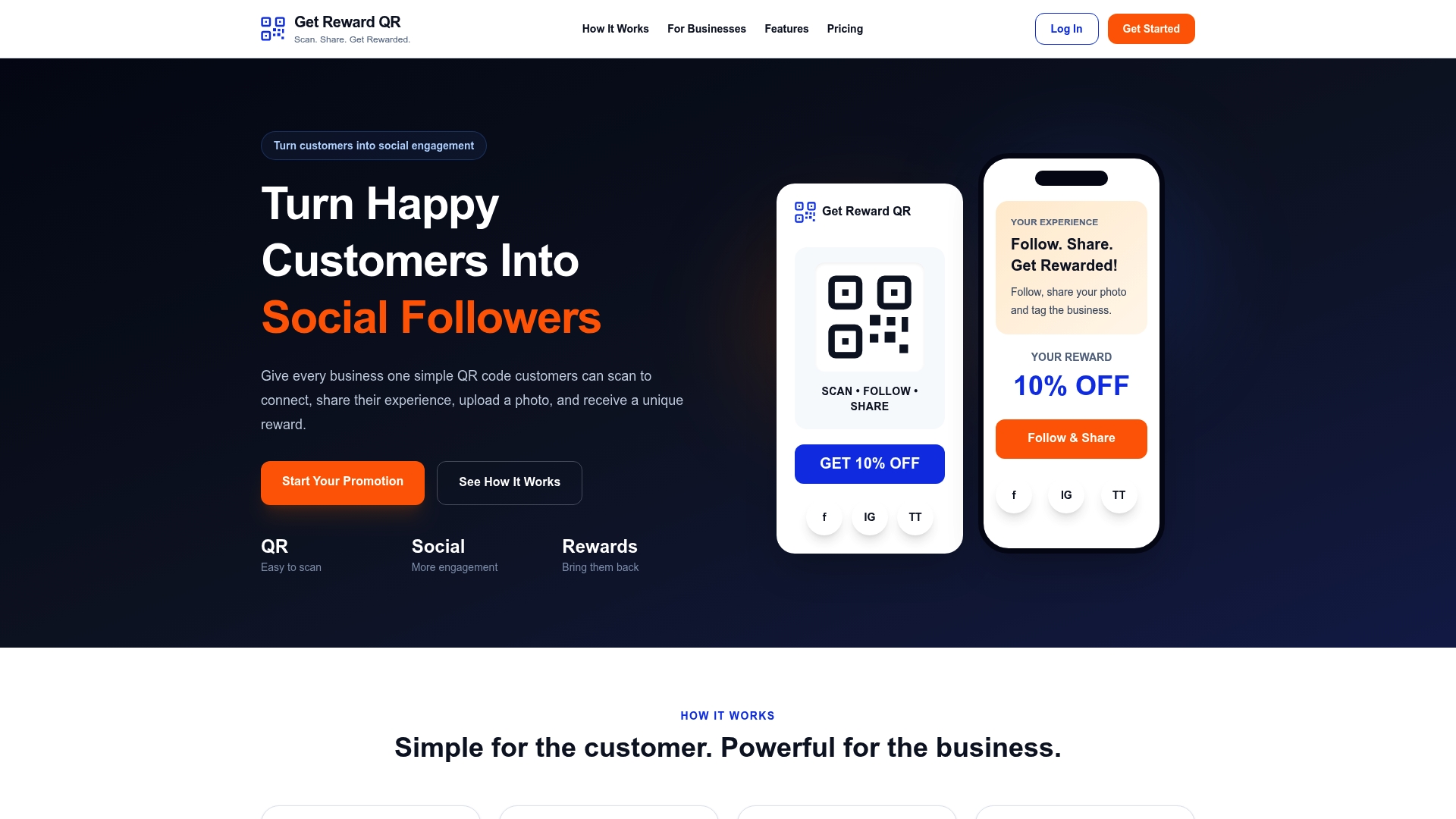
None of this replaces legal advice specific to your market, but it gives you a cleaner starting point than a paper-based or spreadsheet-driven program. If you want to see how campaign setup and analytics work in practice, visit our pricing page for current details on plans and pricing.
FAQ
What are the three R’s of loyalty programs?
The three R’s commonly refer to relevant rewards, recognition of customer value, and relationship building over repeat visits. Compliance intersects with all three: rewards must be eligible as advertised, recognition requires accurate data on customer behavior, and relationship building depends on consent that customers actually gave.
What are examples of loyalty programs?
Common formats include points-per-purchase programs, tiered membership programs with escalating perks, punch-card style visit counters, and QR-based scan-and-follow campaigns that reward social engagement instead of just spending. Each format carries its own eligibility logic, so the compliance requirements around consent and defensible rules apply regardless of which model a business chooses.
How do I manage a loyalty program for compliance?
Start with a documented consent flow, objective and versioned eligibility rules, marketing copy that matches your fine print, and a records system that logs consent, eligibility decisions, and redemptions. Review these elements whenever you change the program or expand into a new market, since rules that worked at launch can drift out of alignment as the program grows.
What are the four C’s of customer loyalty?
Definitions vary, but a common version includes consistency, communication, convenience, and care in how a business treats repeat customers. From a compliance standpoint, communication and consistency matter most: your marketing claims need to consistently match what customers actually receive, which is the core of the “net impression” standard regulators apply to rewards marketing.
How do I ensure my loyalty program stays compliant over time?
Run periodic audits of your consent logs, eligibility rules, and marketing copy rather than treating compliance as a one-time setup task. A tabletop audit, where you simulate producing an evidence package on short notice, is one of the fastest ways to catch gaps before a regulator or customer complaint does.