Launch Social Proof Campaigns in a Day Without an App for Local Shops
Launch Social Proof Campaigns in a Day Without an App for Local Shops

Social proof campaigns use real customer signals, reviews, user-generated photos, popularity cues, to shorten the moment a buyer hesitates and push them toward a decision. The payoff is trust that converts: shoppers who see genuine signals from other customers act faster and buy more often, a strategy well supported by experienced development-led digital agency expertise. The highest-leverage tactics to start with are UGC prompts, visible star ratings, and simple popularity messaging like recent purchase counts.
TL;DR:
- At awareness, use popularity cues and recognizable mentions; near purchase buttons, prioritize recent verified reviews and star ratings over follower counts or celebrity endorsements.
- You may reward customers for submitting reviews, but never condition payment or discounts on positive ratings; fake reviews and undisclosed insider endorsements violate FTC rules.
- Fix service problems before amplifying a weak public rating; when review samples remain small, aggregated customer counts may communicate trust better than star averages.
- Request reviews after delivery or completed service, get permission before reposting content, and track submissions and conversion lift for two to four weeks before scaling.
Table of Contents
- Why Social Proof Works: The Psychology Behind the Funnel
- Twelve Social Proof Tactics You Can Deploy This Quarter
- Running the Campaign: A Step-by-Step Blueprint
- Measuring Impact and Avoiding the Common Traps
- A QR-First Pilot for Local Shops: Scan, Share, Redeem
- When to Invest in Social Proof, and When to Wait
- Put This Playbook on Autopilot With Get Reward QR
- FAQ
- Sources
Why Social Proof Works: The Psychology Behind the Funnel
People default to copying others when they are uncertain, especially when a purchase decision is unfamiliar or risky. This is why a shopper checks reviews before buying a mattress but rarely before buying a pack of gum: the higher the stakes or the newer the product category, the more weight social signals carry.
Not all proof carries equal weight. A recommendation from a friend outranks a verified buyer review, which outranks a general star rating, which outranks a celebrity endorsement for most purchase categories. That hierarchy matters when you decide what to collect first: a handful of detailed verified reviews usually beats a large follower count with no commentary.

Where proof appears also depends on funnel stage. At the awareness stage, popularity cues and media mentions do the work of making a brand feel established. At the purchase stage, specific, recent reviews and star ratings matter more because the buyer is comparing concrete alternatives. Research on trust signals found that star ratings and reviews rank among the most influential signals shown on homepages and product pages, and that consumers can usually name at least one trust signal that changes their likelihood to buy.
Pro Tip: Match the proof type to the funnel stage: popularity and awards near the top of a landing page, specific reviews and ratings right next to the add-to-cart button.
Twelve Social Proof Tactics You Can Deploy This Quarter
Social proof is not one tactic, it is a toolkit. Each format below fits a different budget, business size, and buyer moment.
User-generated content (UGC) campaigns work best when the ask is small and the reward is immediate. A scan-to-share photo prompt at checkout, paired with a branded hashtag contest, turns an ordinary purchase into a piece of marketing content. Pair the prompt with a single-use reward code for a fair and auditable discount system.
Reviews and star ratings belong on product pages, category pages, and checkout flows, not buried on a separate testimonials tab. A visible “verified buyer” badge increases credibility because it signals the review came from an actual transaction rather than an anonymous post. Incentivizing reviews is fine as long as the incentive is not tied to leaving a positive review, a distinction the FTC’s trade regulation rule treats as a compliance line, not a suggestion.
Testimonials and case studies serve different jobs. A short testimonial, one or two sentences with a name and photo, works near a CTA where attention spans are short. A long-form case study, with specific numbers and a named client, works on a dedicated page for considered purchases like software or professional services where the buyer wants proof of outcomes, not just sentiment.
Influencer and micro-influencer activations often outperform celebrity endorsements for conversion because the audience trusts a micro-influencer closer to the credibility level of a verified buyer than a paid spokesperson. Pick micro-influencers whose audience overlaps your buyer profile rather than chasing follower count, and measure the content by engagement rate and resulting site traffic, not reach alone.
Popularity and scarcity messaging such as “X people viewed this today” or “12 sold in the last hour” borrows from the same herd instinct that drives review trust. These overlays work best on high-consideration or inventory-limited products and lose impact fast if the numbers look inflated or static.
Media mentions, awards, and partner logos move the needle mainly at the awareness stage, when a buyer is deciding whether to trust the brand at all before evaluating a specific product. A row of recognizable logos on a homepage does more to establish legitimacy than to close a sale.
A few formats worth testing in sequence:
- UGC photo contest tied to a branded hashtag and a single-use discount code.
- “Verified buyer” badges attached to reviews shown on product pages.
- Short testimonial carousel placed directly above the add-to-cart button.
- One detailed case study page for a considered-purchase product line.
- Micro-influencer unboxing or try-on content shared to a landing page.
- Recent-purchase overlay showing timestamped activity on high-demand items.
- Press logos or industry award badges placed near the site footer or hero section.
Running the Campaign: A Step-by-Step Blueprint
A social proof campaign succeeds or fails on execution discipline, not creative genius. The sequence below works whether you are a solo marketer or running a small team.
- Set the goal and pick the buyer stage. Decide whether this campaign targets awareness (more reach, more logos, more mentions) or purchase conversion (more reviews, more UGC near the CTA), and choose one or two KPIs accordingly.
- Identify champions and moments to ask. The best time to request proof is right after a milestone: a delivered order, a completed service, a loyalty tier upgrade, or an in-store visit. Salesforce’s guidance on social proof recommends using CRM-triggered outreach so requests go out automatically after these moments instead of waiting for customers to volunteer feedback.
- Build the capture flow. This can be an email with a one-click review link, a QR code on the receipt that opens a photo upload form, or a POS prompt that generates a single-use coupon in exchange for a social share.
- Get permission in writing. A short checkbox or reply confirming you can repost their content avoids disputes later and keeps you aligned with disclosure expectations.
- Publish and syndicate. Place the strongest proof near relevant CTAs on the site, build a rotating UGC carousel for the homepage, reuse the best reviews as ad creative, and print a QR code for in-store signage that links back to the same campaign.
- Measure, then scale. Track submission volume and conversion lift for two to four weeks before expanding the offer or increasing the reward.
Keep a short channel checklist as you publish:
- Product pages: reviews and star ratings directly below the price.
- Landing pages: testimonials or case study excerpts above the fold.
- Paid ads: UGC stills or short clips as primary creative.
- In-store or on-receipt: QR code linking to the share-and-review flow.
Compliance belongs inside this process, not bolted on afterward. The FTC’s rule on consumer reviews and testimonials prohibits fake reviews, undisclosed insider endorsements, and rewards conditioned on a customer leaving a positive review. A gift card for “leaving a review” is fine; a gift card for “leaving a five-star review” is not.
Measuring Impact and Avoiding the Common Traps
Treat a social proof campaign like any other marketing investment: define the metrics before you launch, not after.
- Conversion lift on pages where proof elements were added versus a control page.
- Click-through rate on the proof element itself (a badge, a review snippet, a carousel).
- UGC submission volume per week, which tells you whether the ask is actually working.
- Review velocity, the rate of new reviews coming in, which signals whether your capture flow needs attention.
Run A/B tests on badge design, the exact wording of a testimonial headline, placement relative to the CTA, and the density of proof elements on a page, since piling on too many trust badges can read as overcompensation rather than credibility.
One optimization priority matters more than the rest: fix the average rating before you amplify it. If your rating sits below a level you would be proud to put on a billboard, work on service quality and private feedback loops first; once it is solid, use aggregated counts like “500+ happy customers” rather than a shaky star average if your review sample is still small.
Watch for three pitfalls. Fake or incentivized-for-positivity reviews violate the FTC’s consumer review rule and erode trust the moment they are discovered. Displaying a low aggregate rating publicly can do more damage than having no rating at all. And leaning on follower counts instead of engagement quality tends to overstate an influencer’s actual influence on purchase decisions. Authentic, unfiltered customer voices consistently outperform over-polished testimonials because readers can tell the difference, a dynamic the FTC’s rule effectively codifies by discouraging curated-only presentation.
A QR-First Pilot for Local Shops: Scan, Share, Redeem
A local coffee shop, gym, or salon can run a complete social proof pilot in a single day without building an app or hiring a developer. The flow is simple: a customer scans a QR code at the counter, follows or shares the business’s social profile, uploads a photo or tags the location, and receives a single-use coupon on the spot. This is the exact mechanic behind QR-first social media reward flows that turn ordinary visits into shareable content.
To launch it in a day:
- Print table tents or a counter sign with the QR code and a one-line reward offer (“Scan, tag us, get 10% off today”).
- Brief staff on how to redeem the single-use coupon at checkout so there is no confusion at the register.
- Post two or three example UGC posts to your own account first so customers see what the prompt looks like in practice.
- Set a one-week check-in to count scans, shares, and redemptions before deciding whether to extend the offer.
For retail and service businesses layering this onto an existing loyalty motion, a no-app UGC rewards setup pairs naturally with single-use coupon mechanics at the point of sale, since each code can only be redeemed once, which limits coupon sharing and fraud.
Pro Tip: Watch UGC submission count and redemption rate in the first week. If scans are high but shares are low, the ask is too complicated; simplify it to a single tap.
When to Invest in Social Proof, and When to Wait
Social proof campaigns earn priority when the purchase carries real uncertainty: a new product launch, a considered purchase like a service contract, or a local business trying to convert foot traffic into regulars. In these cases, a buyer actively looks for a signal that someone else already took the risk.

The campaign deserves to wait when the underlying product experience cannot support public scrutiny yet. A business with only a handful of reviews or a rating it would not want magnified should fix the experience privately first, through direct outreach and service recovery, before putting a review widget front and center. Publishing too early just broadcasts the weak spot.
Budget scales with ambition. A solo operator can run a meaningful pilot with a QR code, a sign, and an afternoon of staff training. An enterprise program justifies dedicated tooling, influencer budgets, and a syndication partner, but the SMB version is rarely a smaller copy of that, it is a different, leaner playbook built around speed.
— Arturo
Put This Playbook on Autopilot With Get Reward QR
Everything described above, the scan-to-share prompt, the photo upload, the single-use coupon, the POS redemption, is exactly the flow we built Get Reward QR around. We give local businesses a QR-first campaign system: customers scan, follow or share a social profile, upload a tagged photo, and redeem a single-use discount, while staff confirm the redemption through universal POS mode and we track the campaign’s analytics in the background.
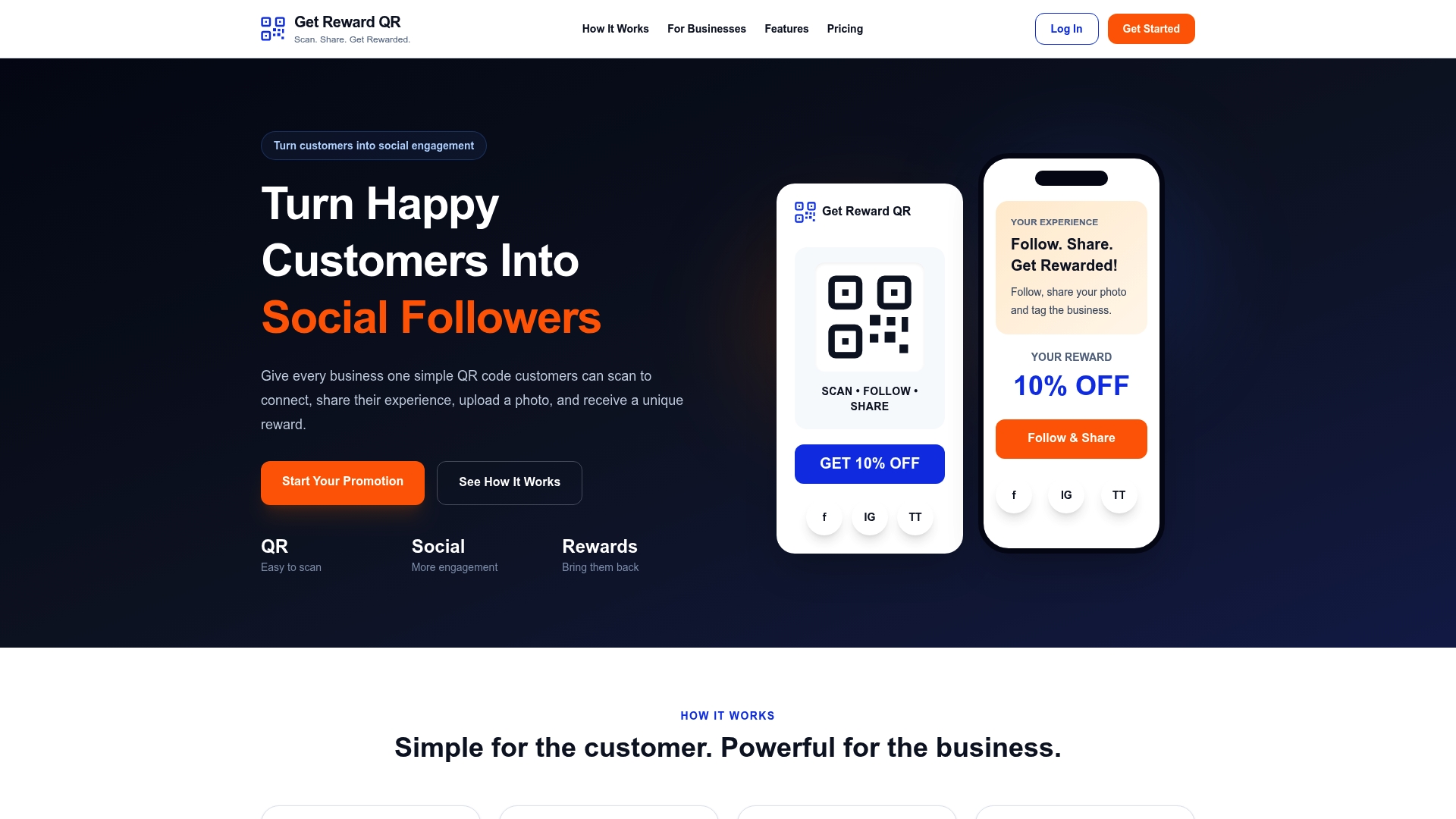
There is no app for customers to download and no developer work for you to manage, just a QR code, a branded offer, and a dashboard showing scans, shares, and redemptions as they happen. If you want to see how the mechanics fit your floor plan and social channels, our pricing page lays out the Monthly plan at $19.99 per month and the Annual plan at $199 per year, both covering the full campaign toolkit. Start a trial and have a working pilot running at the counter before the week is out.
FAQ
Can you provide some examples of social proof ads?
Common examples include ads built from UGC photos or video clips, short testimonial quotes overlaid on product shots, and popularity callouts like “bestseller” or “many sold.” Influencer unboxing clips and star-rating badges pulled directly into paid creative are also widely used formats.
What are the 5 Ps of social marketing?
Definitions vary across marketing frameworks, so there is no single agreed version of “the 5 Ps” specific to social proof marketing. Most practical campaigns instead focus on proof type, placement, permission, publishing, and performance measurement, the actual steps covered in this guide’s campaign blueprint.
What is the 5 5 5 rule on social media?
This term is used inconsistently across sources and has no fixed, universally agreed definition tied to social proof campaigns specifically. Rather than following an unverified rule, focus on the tested fundamentals here: capture proof at the right moment, publish it near your CTA, and measure conversion lift.
How do I collect reviews without breaking FTC rules?
You can ask for a review and even offer a small incentive for leaving one, but the incentive cannot be conditioned on the review being positive, and any insider or paid relationship must be disclosed. The FTC’s trade regulation rule on consumer reviews treats fake reviews and conditioned incentives as prohibited practices.
Does user-generated content actually increase conversions?
Large-scale syndication of authentic reviews and UGC has produced substantial conversion uplifts for major beauty brands when deployed broadly across product pages. For smaller businesses, even modest UGC volume tends to build trust because the content reads as unscripted and specific rather than polished marketing copy.
Sources
- The Psychology Behind Trust Signals
- Trade Regulation Rule on the Use of Consumer Reviews and Testimonials
- What is Social Proof? Everything You Need to Know
- Case Study: L’Oreal Luxe | Bazaarvoice