Small Businesses: Three Tier Rewards Program, No App
Small Businesses: Three Tier Rewards Program, No App

A tiered rewards program sorts customers into ranked levels, usually three to four, based on spend, points, or order frequency, then grants better perks the higher they climb. The goal is to nudge customers toward specific, achievable spending milestones while concentrating your most expensive rewards on a select portion of high-value buyers. If you already have repeat customers and even basic purchase history data, this structure typically outperforms a flat points system.
TL;DR:
- Tiered programs best reward high-value customers by concentrating costly benefits on the top segment, often achieved with three to four levels for clarity.
- Setting realistic thresholds based on actual customer data, such as low entry spend or activity, ensures engagement from casual and regular clients alike.
- Experiential perks like early access or exclusive content at top tiers can create emotional loyalty without significant margin impact.
- Clear rules on tier duration, downgrades, and refunds prevent member dissatisfaction and support transparency across channels.
- Using simple, real-time data integrations and pilot testing before full deployment helps avoid common pitfalls and measures ROI accurately.
Table of Contents
- How Tiered Loyalty Programs Work: Qualification Methods and Currencies
- Why Tiers Work: The Psychology Behind Customer Loyalty Levels
- How to Design Tiers: Thresholds, Rewards Mix, and Exclusivity
- Setting the Rules: Tier Duration, Downgrades, and Refunds
- Implementation Checklist: Data, Integrations, and Testing
- Measuring ROI: KPIs and Reward-Cost Modeling
- Program Patterns by Business Type: Retail, Subscription, and Local Services
- Common Pitfalls That Sink Tiered Programs (And How to Fix Them)
- What Actually Moves the Needle in the First Few Months
- Running a Tiered Program Without an App: The Get Reward QR Approach
- Sources
- FAQ
How Tiered Loyalty Programs Work: Qualification Methods and Currencies
A tiered rewards program differs from a flat points system in one key way: it ranks members instead of treating everyone the same. In a flat program, 100 points buy the same reward whether you’re a first-time buyer or a five-year regular. In a tiered structure, that same regular sits in a higher bracket with better redemption rates, early access, or perks a casual shopper never sees.
Businesses qualify members for tiers using a handful of common methods, and each one carries operational tradeoffs worth understanding before you build anything:
- Amount spent — Simple to track and directly tied to revenue, but it can penalize high-frequency, low-ticket customers.
- Points earned — Flexible and easy to gamify, but points inflation can quietly erode the value of top tiers over time.
- Number of orders — Rewards frequency over dollar amount, which fits subscription and service businesses better than big-ticket retail.
- Time windows — Rolling 12-month periods, calendar-year resets, or lifetime totals each change how “sticky” a tier feels.
According to LoyaltyLion’s guidance on tier mechanics, the qualification mode you pick affects both member experience and how cleanly you can report on program performance. A lifetime-spend model, for instance, never resets, which feels generous to customers but makes it harder to reward recent engagement.
Most mature programs also separate two concepts: points and status. Points are the transactional currency members redeem for discounts or products. Status is the tier itself, the badge that unlocks ongoing perks regardless of whether points get spent that month. Keeping these separate lets you run promotions on points without accidentally bumping someone’s tier, and it lets you protect tier status as the more durable, prestige-driven asset. Three to four tiers is generally considered a practical number. Add a fifth or sixth, and most customers lose track of where they stand or what the next step even buys them.

Why Tiers Work: The Psychology Behind Customer Loyalty Levels
Tiered programs exist because they solve two business problems at once: they lift spend from customers who are close to a threshold, and they let you concentrate your most expensive perks on the smallest, most profitable segment instead of spreading rewards thin across everyone.
Mastercard’s analysis of tiered loyalty programs notes that tiers let businesses lock in future spend and build genuine emotional attachment, but only when the thresholds feel within reach. Set the bar too high, and customers disengage before they ever try to climb.
The math behind tier concentration: Rather than spreading perks evenly across a customer base, tiered programs deliberately funnel the richest benefits to a relatively small top share of spenders. That concentration is what makes the economics work: a small segment gets outsized rewards, funded by the incremental spend that same segment already generates.
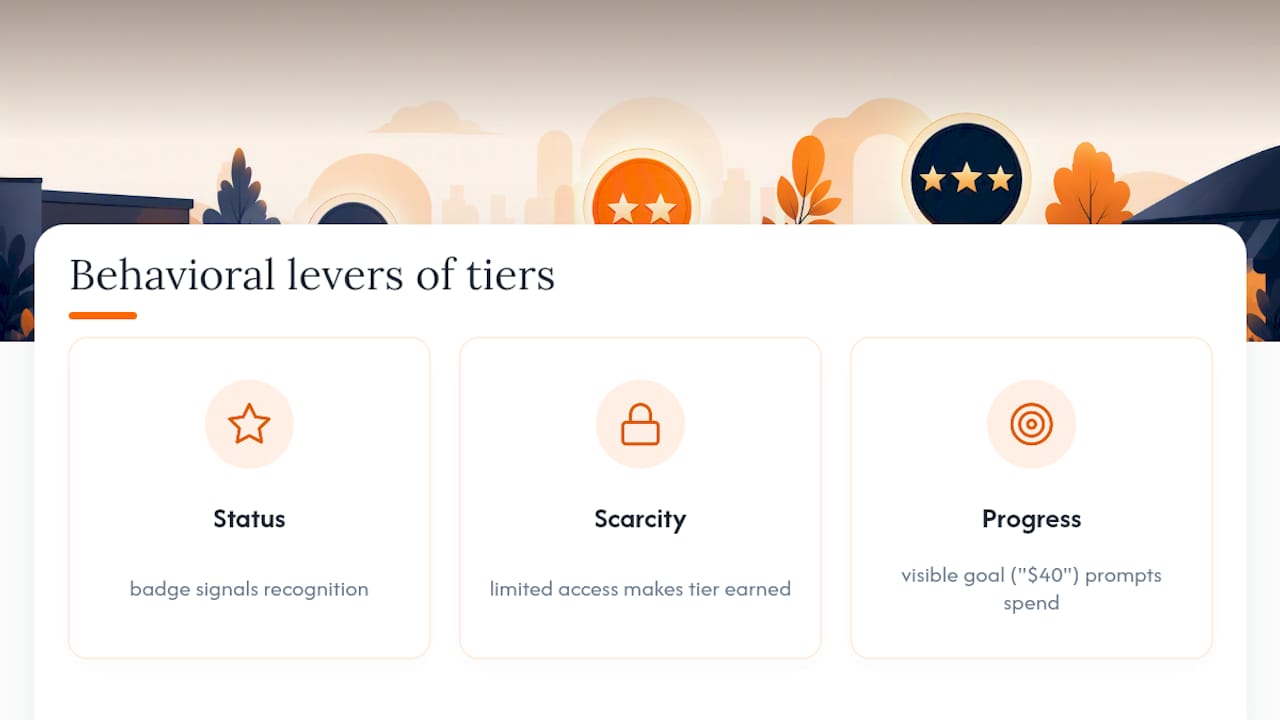
The behavioral mechanics driving this are familiar to anyone who has ever chased a status level on an airline or a credit card. Three levers do most of the work:
Status taps into a basic human desire to be recognized as different from the average customer. A gold-tier badge next to your name at checkout signals something, even if the discount attached to it is modest.
Scarcity makes the top tier feel earned rather than handed out. If everyone eventually reaches your highest level, it stops motivating anyone to work toward it.
Progress nudges work through visible momentum: a bar that says “$40 to your next tier” converts abstract loyalty into a concrete, short-term goal. That’s a more effective prompt than a generic “shop more, save more” message.
Tiering can backfire, though, in a few predictable ways. If thresholds are calibrated against your best customers instead of your average ones, most members will never see the second tier, let alone the third. If you change the rules after launch, especially by making the program stingier, expect vocal pushback; taking away an earned benefit generates far more resentment than never offering it did in the first place.
How to Design Tiers: Thresholds, Rewards Mix, and Exclusivity
Start with the number of tiers, because it constrains everything downstream. Three to four levels is the range that shows up repeatedly across successful programs, as more levels increase complexity and reduce clarity. A five or six-tier structure sounds impressive in a pitch deck, but most members can’t hold that many distinctions in their head, and engagement tends to flatten past the fourth level.
Once you’ve settled on tier count, the next decision is where to set the thresholds, based on your own customer spending patterns. This is where a lot of programs quietly fail. Set the entry bar too high, and you lose the casual customer before they ever engage with the program at all. Businesses often anchor the first tier around a low, easily hit amount, typically in the range of tens of dollars in cumulative spend, so new customers can cross into “member” status within their first visit or two and start forming the habit early. Higher tiers should scale up meaningfully but stay grounded in what your actual purchase data shows is achievable for a motivated regular, not your single best whale customer.
Rewards mix matters just as much as threshold placement. You’re balancing two categories:
- Transactional rewards — discounts, cashback, free shipping, points multipliers. These drive short-term purchase behavior and are easy for customers to value.
- Experiential rewards — early access to new products, invite-only events, priority service, exclusive content. These cost you comparatively little in hard margin but carry outsized perceived value.
Yotpo’s research on tiered loyalty design points out that experiential perks are one of the more efficient levers available, since gating early access or exclusive events costs almost nothing per member while still feeling like a real privilege. A smart tier structure leans on transactional rewards at the entry and middle levels, where price sensitivity still drives behavior, and shifts toward experiential perks at the top, where the goal is emotional loyalty rather than another discount code.
For businesses that want an extra layer of exclusivity, three variations are worth considering:
- Paid tiers, where customers pay an upfront or annual fee for guaranteed top-level benefits, work well when the perks are genuinely premium enough to justify the cost.
- Invite-only tiers let you reward your highest-value customers without publishing the exact threshold, which protects against gaming the system.
- Hidden tiers operate quietly in the background, flagging VIP customers to staff for informal perks without a public program structure at all.
Pro Tip: Before publishing any threshold publicly, run it against your last 12 months of actual customer spend data. If fewer than 15 percent of active customers would currently qualify for your second tier, the bar is probably set for your aspirational customer, not your real one.
Setting the Rules: Tier Duration, Downgrades, and Refunds
Every tiered rewards program needs a policy for how long a tier lasts, and this decision shapes member behavior more than almost any other design choice. You have three broad options, each with real tradeoffs.
- Rolling windows (typically 12 months) measure spend on a continuous basis, so a customer’s tier reflects their most recent year of activity at any given moment. This keeps the program responsive to current engagement, but it also means someone can lose status simply because a big purchase fell just outside the window.
- Calendar-year resets align tier evaluation to a fixed date, which simplifies reporting and gives customers a predictable annual cycle, but it creates an awkward incentive: heavy spending in December to lock in status, followed by a lull in January once the reset has happened.
- Lifetime tiers never reset at all. They reward long-term loyalty generously and never punish a slow year, but they eventually stop motivating fresh spend since the status is already locked in permanently.
LoyaltyLion’s documentation on tier structures frames this choice as one of the first decisions to make, since it affects how you build every downstream rule, including downgrades.
Downgrade policy is where a lot of goodwill gets won or lost. A hard cliff, where a customer drops a full tier the instant they miss a threshold, feels punitive and generates complaints. A grace period, commonly 30 to 90 days, gives members a warning and a chance to top up their spend before losing status. Some programs soften the landing further with a “half step” down rather than a full drop, which keeps the loss from feeling catastrophic and preserves the relationship instead of severing it.
Refunds and returns need explicit handling too, and this is a detail many programs overlook until a support ticket forces the issue. If a customer’s return drops their qualifying spend below a threshold, does their tier get recalculated immediately, at the next cycle, or not at all? Most programs land on recalculating only at the next scheduled review point rather than in real time, since real-time downgrades tied to returns feel arbitrary and invite disputes.
Whatever rules you land on, the communication layer matters as much as the policy itself. A member who understands exactly why they moved tiers, and what it takes to move back, stays far more forgiving than one left guessing. Clear transactional emails, an always-visible progress bar in-app or on-site, and plain language over jargon (skip terms like “qualifying net revenue” in favor of “amount spent”) all reduce the support burden and the resentment that comes with an opaque system.
Implementation Checklist: Data, Integrations, and Testing
Rolling out a tiered rewards program is fundamentally a data project before it’s a marketing one. Get the technical foundation wrong, and no amount of clever reward design will save the launch.
- Audit your data first. You need customer identifiers that persist across channels, historical spend records, order frequency, and ideally purchase dates going back at least 12 to 24 months to model realistic thresholds. If your data lives in disconnected systems, this step alone can take longer than building the program itself.
- Map your privacy obligations. Tiered programs rely on tracking individual purchase behavior over time, so confirm your data retention and consent practices align with whatever regulations apply to your customer base before you start collecting anything new.
- Choose your integration points. At minimum, you need your program logic talking to your POS or ecommerce platform (to log qualifying purchases), your CRM (to store tier status), and your email or SMS system (to communicate tier changes). Open Loyalty’s documentation on tier software emphasizes that real-time API access between these systems prevents the classic failure mode where a customer’s in-store tier status doesn’t match what shows up online.
- Build for real-time status exposure. Staff at checkout and customers browsing your site should see the same tier information at the same time. A delay of even a day between purchase and status update creates confusion and support tickets.
- Pilot before full rollout. Run threshold simulations against your historical data to see how many customers would land in each tier under different rules, then test the live experience with a small cohort before opening it to everyone.
- Phase the launch. Start with your most engaged existing customers, watch how they move through tiers over four to eight weeks, then expand.
Pro Tip: Run your threshold simulation twice, once against last year’s full customer base and once against only customers who made a repeat purchase. The gap between those two results tells you whether your thresholds are realistic for loyal customers or only for your biggest one-time spenders.
Measuring ROI: KPIs and Reward-Cost Modeling
A tiered rewards program is only worth running if you can prove it changes behavior, and that means tracking a specific set of numbers from day one rather than waiting until year-end to ask if it worked.
The core metrics worth watching on a recurring basis:
- Progression rate — the percentage of members who move up a tier within a given period, which tells you whether your thresholds are motivating or ignored.
- Retention by tier — repeat-purchase rate segmented by tier level, since a well-designed program should show meaningfully higher retention as members climb.
- Incremental purchase rate — purchases directly attributable to chasing or maintaining tier status, distinct from baseline buying behavior.
- Average order value (AOV) by tier, which typically rises as customers approach a threshold.
- Customer lifetime value (CLTV) uplift, comparing program members against a matched non-member cohort.
The harder but more important calculation is reward cost against net incremental margin. That means tallying what you actually paid out in discounts, free products, or experiential perks per tier, then subtracting that from the extra revenue those same members generated compared to a similar non-member group. Open Loyalty’s guidance on tier program economics recommends modeling this with control groups rather than assuming top-tier spend is purely additive, since some of that spend would have happened anyway.
Cohort analysis is what makes this credible. Split customers into a program group and a control group with similar purchase histories at launch, then track the gap in spend and retention over the following two to three quarters. Getting comfortable with this kind of analytics setup is its own project. Resources like HybridMinds’ guide to conversion tracking walk through the fundamentals of building measurement dashboards that small and midsize teams can actually maintain without a dedicated data analyst.
Your dashboard should track, at minimum: current distribution of members across tiers, monthly movement (upgrades and downgrades), average time spent in each tier, and reward redemption rate. Open Loyalty notes that distribution monitoring catches calibration problems early, whether that means too many members clustered in the entry tier or, just as telling, an oversized top tier that’s quietly draining margin.
Program Patterns by Business Type: Retail, Subscription, and Local Services
The right tier structure depends heavily on how often customers naturally interact with your business and what your margins can absorb.
Retail businesses typically build an entry tier around a low, fast-to-reach spend threshold that gets new customers into the habit of returning. The middle tier then layers in perks specifically designed to lift average order value, things like free shipping thresholds or bonus point multipliers on larger carts. The top tier shifts almost entirely to experiential rewards: early product access, invite-only sales, or exclusive events that cost little relative to the loyalty they generate.
Subscription businesses face a different problem. There’s often no single large “purchase” to measure, so tenure and engagement become the qualifying metrics instead of spend. A media or software subscription might tier customers by months active, feature usage, or referral activity rather than dollars spent, since the goal is reducing cancellation, not driving a bigger single transaction.
Local service businesses, restaurants, gyms, and salons among them, benefit from shorter qualification windows because visit frequency is naturally higher and more visible. A gym might use a 90-day rolling window tied to visit count rather than dollars. A salon might reward tier status with service credit rather than discounts, since a free add-on service costs less than a straight percentage off. These businesses also depend heavily on staff being able to see and honor tier status at the point of redemption, which makes simple, visible verification more important than complex point calculations.
- High-frequency, low-margin businesses (cafes, gyms) tend to favor shorter windows and service-based rewards.
- Low-frequency, high-margin businesses (furniture, electronics) can afford longer windows and richer experiential perks.
- Recurring-revenue businesses should weight tenure and usage over transaction size entirely.
Common Pitfalls That Sink Tiered Programs (And How to Fix Them)
Most failed tiered rewards programs die from the same handful of mistakes, and nearly all of them are fixable before launch if you catch them early.
Complexity kills engagement fastest. If members can’t explain their own tier’s benefits in one sentence, the rules are too complicated. Fix it by cutting to three tiers, using plain language everywhere, and testing your program explanation on someone outside your team before launch.
Top-tier dilution happens when too many customers reach the highest level, and the status stops feeling special. Mastercard’s research points to recalibrating thresholds against actual distribution data, or introducing an invite-only tier above the current top level to restore scarcity.
Poor measurement means you’re flying blind on whether the program even works. Set up your control group and cohort tracking before launch, not six months in when you’re already trying to explain results to leadership.
Frequent rule changes erode trust fast, especially when they take benefits away. Communicate any change well in advance, phase it in gradually, and grandfather existing members into old terms whenever possible.
Pro Tip: If you must tighten a benefit, pair the change with something new elsewhere in the program. A straight benefit cut generates complaints; a “we’re updating tier X” email that adds one perk while adjusting another reads as evolution rather than a takeaway.
What Actually Moves the Needle in the First Few Months
The programs that work in their first ninety days share one trait: they set thresholds against real customer data instead of guesswork, and they resist the urge to launch with five or six tiers because it looks more sophisticated. A tight three-tier structure with a genuinely low entry bar consistently outperforms an elaborate system nobody fully understands.
A launch readiness checklist worth running before go-live: confirm your data pipeline reflects at least 12 months of purchase history, verify tier status displays identically at checkout and online, pilot with a small cohort before full rollout, and have your downgrade and refund policy written down before a customer forces the question. Programs that skip that last step almost always end up improvising an answer under pressure, which rarely goes well.
What surprises most first-time program owners is how much the experiential perks matter relative to their cost. A discount feels transactional even when it’s generous. An invite to a private event or early access to inventory feels personal, even when it costs you almost nothing to provide. That asymmetry is where the real leverage sits.
— Arturo
Running a Tiered Program Without an App: The Get Reward QR Approach
Everything above assumes you have the systems, integrations, and engineering time to build tier logic, expose real-time status, and train staff on a POS integration. Not every restaurant, gym, or salon owner has that runway, and that’s the gap Get Reward QR is built to close.
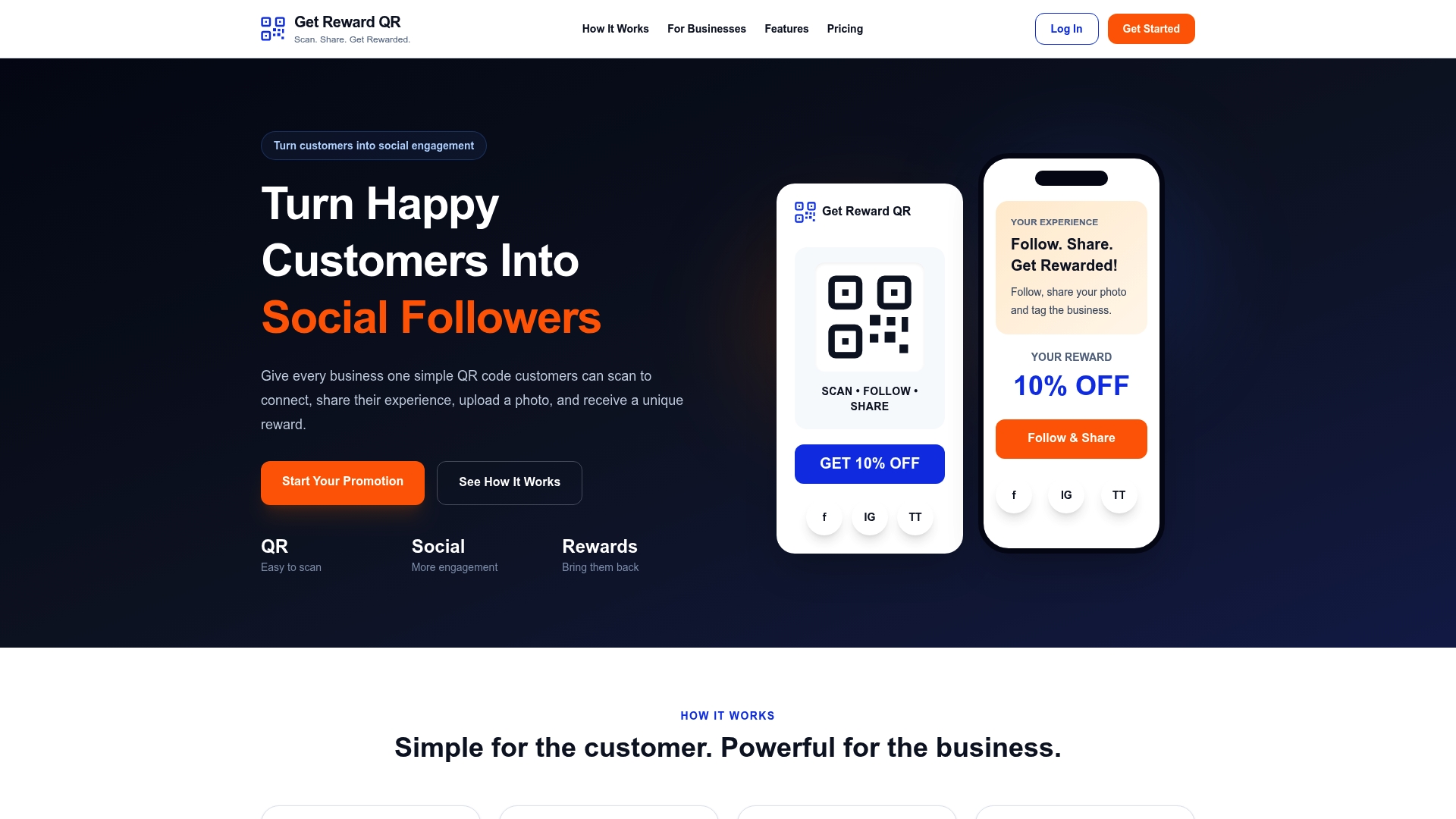
Get Reward QR runs an entire rewards campaign through a QR code your customers scan at checkout, no app download required. Customers follow your social profiles, upload a photo, or tag your business, and get a single-use coupon in return. Your staff redeem it through a universal POS mode that works regardless of what register system you already run, and you get campaign analytics showing exactly how engagement translates into repeat visits. For a local business that wants the progression and exclusivity benefits of a tiered structure without months of integration work, that QR-first model is the practical middle ground between a manual punch card and a full enterprise loyalty platform.
It fits best for restaurants, gyms, salons, and small retailers who want customers coming back and sharing their experience online, without asking anyone to download yet another app. Plans run $19.99 a month or $199 a year on the pricing page, and you can see the full feature set on the Get Reward QR site before committing to a plan.
Sources
- Do tiered loyalty programs work? | Mastercard
- Building tiers & how they work | LoyaltyLion Help Center
- Tiered Loyalty Program Software | Yotpo
FAQ
How do I redeem my loyalty points?
Redemption depends entirely on the program you’re enrolled in, but most tiered systems let you exchange accumulated points for discounts, free items, or credit toward a purchase either online or at checkout. Check your account dashboard or ask staff directly, since redemption rates and minimums vary by tier level.
What does “tiered membership” mean?
Tiered membership means you’re ranked into one of several levels, commonly three to four, based on how much you spend, how often you purchase, or how long you’ve been a customer. Each level unlocks progressively better perks, with the top tier typically reserved for your most valuable or frequent customers.
How much are 10,000 loyalty points worth?
Point values vary widely by program since each business sets its own conversion rate, so there’s no universal dollar figure. Check the specific program’s redemption chart, since a business running a QR-based single-use coupon model like Get Reward QR may reward engagement directly with a coupon rather than an accumulated points balance.
What are rewards tiers?
Rewards tiers are the ranked levels within a loyalty program, each one granting different benefits based on a customer’s spend, points, or activity. Businesses use them to concentrate their highest-value perks on their most engaged customers rather than spreading identical rewards across everyone.
How many tiers should a small business start with?
Three tiers is the safest starting point for most small businesses, since it’s enough to create a sense of progression without overwhelming customers or your own team with rules to track. You can always add a fourth tier later once you have real distribution data showing customers are moving through the existing structure.