Small Businesses: Table Tent QR That Tracks Scans and Delivers Rewards
Small Businesses: Table Tent QR That Tracks Scans and Delivers Rewards

The fastest reliable setup for most small businesses is a double sided cardstock table tent roughly 4 by 6 inches, or an acrylic insert if you want it to last years, paired with a dynamic QR code printed at about 4 by 4 centimeters minimum. Get a dynamic table tent QR code from a generator that lets you edit the link later, print one physical proof, and scan it with two or three different phones before you commit to a full batch. Skip that test and you risk a stack of tents nobody can actually scan.
TL;DR:
- Dynamic QR codes allow link updates without reprinting, reducing wasted materials and ensuring ongoing campaign relevance.
- A minimum size of 4 by 4 centimeters (preferably 5 by 5 centimeters) is recommended to ensure reliable scanning in typical restaurant lighting.
- Test each design with a folded proof and multiple devices to confirm scan ability before placing a full order.
- Laminated cardstock lasts three to twelve months, while acrylic systems can endure for two years or more with reuse.
- Using tracking links and analyzing scan-to-conversion rates helps optimize placement and content for better customer engagement.
Table of Contents
- What Are the Best Templates and Product Options for Table Tent QR Codes?
- What Size and Material Should You Choose for a Table Tent?
- How Do You Design a QR Code That Actually Scans?
- What Does Printing and Ordering Actually Cost?
- How Do You Measure and Improve QR Code Scan Rates?
- What I’ve Learned Watching Small Businesses Get This Wrong
- Turn Every Scan Into a Repeat Customer With Get Reward QR
- Sources
- FAQ
What Are the Best Templates and Product Options for Table Tent QR Codes?
Three routes get you to a finished table tent QR code sign, and each fits a different kind of business.
Online design studios (think drag-and-drop platforms) work best if you want full control over branding and you’re comfortable uploading your own QR image. Print-on-demand services like Vistaprint often include a built-in QR generator or accept a high-resolution PNG or SVG file, plus free layout help if your design skills are rusty. Custom sign makers, meanwhile, are worth the extra cost when you need acrylic inserts, wood stands, or an odd shape that a template library won’t have.
- DIY templates make sense for a single location testing a new promo or seasonal menu.
- Print-on-demand fits multi-location brands that need consistent branding fast.
- Custom makers suit restaurants or salons investing in a permanent tabletop fixture.
Turnaround varies by vendor, but most print services process orders placed before a daily cutoff the same day, according to Signs. Tents typically ship flat and fold into shape in seconds, so setup at the venue takes almost no time.
What Size and Material Should You Choose for a Table Tent?

Size and stock choice determine whether your table tent QR code sign looks disposable or genuinely part of the room. Common formats include approximately 4.25 by 6 inch sizes for everyday use and somewhat larger 5 by 7 inch options when more display or copy space is needed, according to Signs.com. A 7 by 5 landscape orientation works well for promo codes and event announcements where the QR sits beside a short headline.
Paper weight and coating matter more than most owners expect:
- Lightweight and inexpensive cardstock options suit short-term promos.
- Heavier cardstock options provide better durability for daily restaurant use.
- Gloss coating makes colors pop but can create glare that interferes with scanning under bright lights.
- Matte or UV coating cuts glare and tends to photograph better for social sharing.
Acrylic inserts and wood stands cost more upfront but pay off over time. Laminated cardstock runs roughly $1 to $3 per unit and lasts three to twelve months, while a reusable acrylic insert system runs $8 to $25 and holds up for two years or more, per Menujo’s cost breakdown. Wood stands sit at the premium end, $15 to $40 each, but they essentially never wear out and only need a paper insert swap when your offer changes.
How Do You Design a QR Code That Actually Scans?
A table tent QR code menu or promo sign fails for one of three reasons: it’s too small, it lacks contrast, or the code sits across a fold. Fix those three and you’ve solved 90 percent of scan problems.
- Size it to the distance. A reliable formula is code width equal to scan distance divided by 10, and most hospitality settings need at least 4 by 4 centimeters, with 5 by 5 centimeters as the safer target.
- Keep contrast high and protect the quiet zone. Dark modules on a light background scan best, and you need roughly four modules of clear margin around the code with no logo, text, or crease crossing it.
- Export correctly. Save as SVG for crisp scaling at any print size, or 300 DPI PNG at the final dimensions if your printer requires a raster file, following UQR’s export guidance.
- Use a dynamic QR code, not a static one. A dynamic code lets you redirect the link after printing, which matters the moment your menu, offer, or landing page changes.
- Tag the link for tracking. Add a query parameter like
?src=tabletentso your analytics can separate table scans from social or print-ad scans.
Pro Tip: Print one test tent, fold it exactly as it will sit on the table, then scan it with an iPhone and an Android phone in both bright and dim light. A code that scans perfectly on your desk can fail once it’s standing at an angle under a dim dining room bulb.
Keep your logo small and off to the side so it never competes with the scan area.

What Does Printing and Ordering Actually Cost?
Never send a design straight to a full print run. Print one proof first, scan it on multiple phones in different lighting, and only then place the bulk order. Skipping this step is the single most common reason businesses end up with a box of table tents nobody can scan.
- Laminated cardstock: $1 to $3 per unit, lasting three to twelve months before edges wear or ink fades.
- Heavyweight cardstock (14 pt): $2 to $5 per unit, holding up six to twelve months under regular handling.
- Acrylic insert systems: $8 to $25 per reusable holder, lasting 24 months or longer since you’re only swapping the paper insert.
- Wood stands: $15 to $40 each, essentially indefinite, ideal for a permanent fixture you’ll rarely redesign.
These ranges come from Menujo’s pricing data, and they scale down fast in volume, most print shops offer per-unit discounts once you cross 50 or 100 pieces.
If you want per-table analytics, generate unique dynamic codes in bulk from a CSV file rather than hand-creating each one. Reusable acrylic stands make the most sense once you’re changing offers often enough that reprinting paper every time becomes a hassle.
How Do You Measure and Improve QR Code Scan Rates?
Most table tent QR code campaigns never get measured at all, which is exactly why so many owners assume they “don’t work” when the real issue is bad placement or a code that’s too small.
- Establish a baseline. Track scan rate as scans divided by customers served, collected over at least seven days to smooth out slow nights and weekend spikes.
- Split traffic by table or zone. Assign dynamic codes per table or section so you can see whether patio seating scans more than the bar, then tag each with its own query parameter.
- Prioritize changes with PIE. Score each idea (bigger QR, better CTA, new placement) on Potential, Importance, and Ease, and tackle the highest scorer first rather than testing everything at once.
- Wait for a real sample size before declaring a winner. A weekend of data from a slow Tuesday shift will lie to you.
- Track scan-to-conversion, not just scans. A code that gets scanned a lot but produces no signups, orders, or reviews isn’t actually doing its job.
What I’ve Learned Watching Small Businesses Get This Wrong
The checklist is short: choose your material, create a dynamic QR code, print and scan-test one proof, then deploy and measure. Almost every table tent failure I’ve seen traces back to skipping step three. Owners rush a design to a 200 piece print order, only to discover the code was 3 centimeters and unreadable under dim lighting, or that a fold line cut straight through the quiet zone.
The other recurring mistake is treating the QR as a one-time decoration instead of a channel you manage. A code that points to a static landing page in January is still pointing there in June, long after the promotion ended, because nobody built in a way to update it. Dynamic codes fix that. Businesses that actually check their scan rate, even loosely, tend to catch these problems within a week instead of a full print cycle.
— Arturo
Turn Every Scan Into a Repeat Customer With Get Reward QR
A well-designed table tent gets you the scan. What happens after that scan is where most setups quietly fall apart, a customer lands on a static menu page and never comes back. Get Reward QR is built for that exact gap: a customer scans your table tent, connects with your social profiles or shares a photo, and gets a single-use coupon on the spot, all without downloading an app.
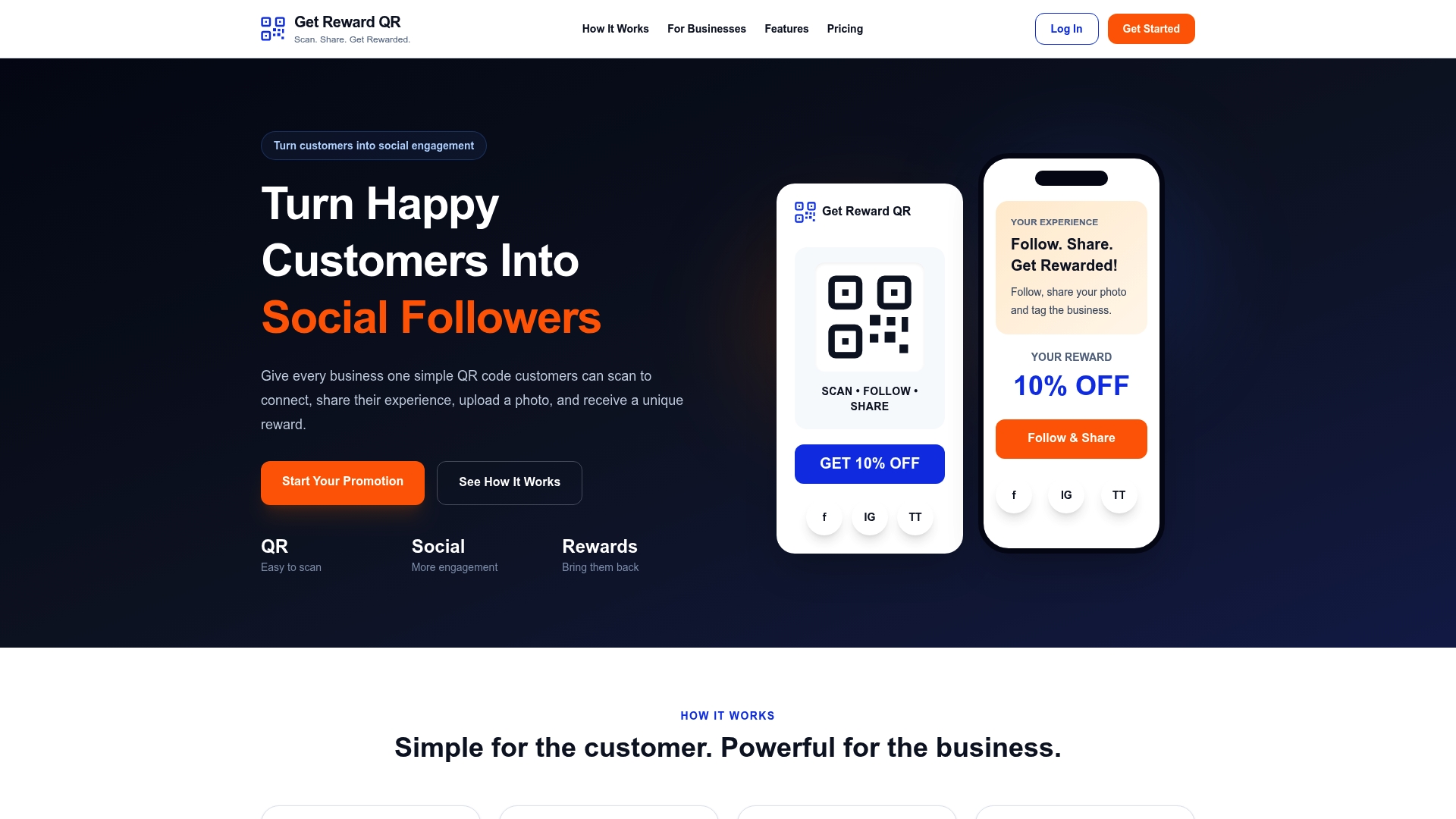
The platform maps directly onto the buyer’s job here. Scan leads to a social connect or reward step, which leads to coupon issuance, which feeds back into campaign analytics you can actually read, no separate QR tracking tool required. It fits best when you already know you want built-in rewards, social sharing, and staff-side coupon redemption at the register through universal POS mode, rather than piecing together three different tools to get there. Pricing runs $19.99 a month or $199 a year on Get Reward QR’s Monthly and Annual plans. If you’re setting up your first batch of table tent QR codes this month, start with the Get Reward QR platform and pick the plan that matches how many locations you’re running.
Sources
For specs, sizing, and templates, Signs.com and Vistaprint cover paper stock and print-ready file requirements. For QR sizing and dynamic-code setup, see UQR and Menujo. For measurement approaches, QRlytics covers baseline scan-rate testing.
- QR Code on Table Tents: Size to Scan, Edit After Print | UQR
- Menu on Table Tents — QR Card Setup Guide | Menujo
- Signs
- Table Tents | Vistaprint
- Do your QR code table tents get scanned? | QRlytics
FAQ
What Size Should a Table Tent QR Code Be?
Aim for a minimum of 4 by 4 centimeters, with 5 by 5 centimeters as the safer target for typical seated scanning distances, based on a rule of code width equal to scan distance divided by ten. Anything smaller risks failed scans under normal restaurant lighting.
Can You Update a QR Code After the Table Tent Is Printed?
Yes, if you use a dynamic QR code instead of a static one. A dynamic code lets you change the destination link anytime without reprinting a single tent.
How Often Should You Replace Table Tent QR Signs?
Laminated cardstock typically lasts three to twelve months before edges wear or colors fade, while acrylic insert systems last two years or more since only the paper insert needs swapping. Replace sooner if the code’s contrast or surface gets damaged enough to affect scanning.
Is Acrylic or Cardstock Better for a Table Tent QR Code?
Cardstock is cheaper and faster to update, making it ideal for short-term promotions or frequent menu changes. Acrylic costs more upfront but survives daily handling far longer, so it pays off if you’re running the same core offer for months at a time.
Does Get Reward QR Work Without a Static QR Code Generator?
Yes, Get Reward QR generates the reward-linked QR code directly inside the platform, so you don’t need a separate QR tool alongside it. The code handles the social connect, coupon issuance, and analytics tracking in one flow, and plans start at $19.99 a month.