Launch Restaurant Loyalty Ideas in 60 Days With QR First Plans
Launch Restaurant Loyalty Ideas in 60 Days With QR First Plans

The most reliable approach for most restaurants combines a simple points or digital punch system with occasional experiential perks, delivered through low-friction technology like QR codes rather than a dedicated app. The highest-impact ideas to start with are a QR-based digital punch card, points tied to order value, and a one-click referral offer. Each is measurable within 60 to 90 days and requires little staff training to run.
TL;DR:
- Simple QR-based punch cards typically achieve high completion rates and require minimal staff training, making them effective for basic loyalty programs.
- Loyalty strategies tied to order value or referral links provide measurable engagement within 60 to 90 days and are easy to implement with existing systems.
- Successful programs emphasize clear rules, consistent rewards across channels, and personalization based on guest behavior to maintain long-term engagement.
- Matching loyalty ideas to visit frequency and check size optimizes effectiveness, with quick-service restaurants benefiting from rapid, low-effort rewards and fine dining prioritizing exclusivity and experience.
- Modular solutions like Get Reward QR enable fast, app-free campaigns with real-time analytics, suitable for quick rollout and accurate measurement of program impact.
Table of Contents
- 1. Top 10 practical loyalty ideas with examples and implementation notes
- 2. What successful restaurant loyalty programs have in common
- 3. How to pick the right loyalty ideas for your concept
- 4. Implementation checklist: launch a simple loyalty program in 60 days
- 5. How to measure success and calculate ROI
- 6. QR-first loyalty: practical implementation notes
- 7. What operators consistently get right, and wrong
- 8. Get Reward QR: an easy way to run scan-driven loyalty campaigns
- Sources
- FAQ
1. Top 10 practical loyalty ideas with examples and implementation notes
Restaurants do not need an elaborate rewards ecosystem to see results. Research from the National Restaurant Association found that a large majority of consumers say they are more likely to visit a restaurant where they can earn points, and many limited-service operators reported that loyalty programs helped increase traffic in 2024. The ideas below are ordered roughly from lowest to highest complexity.
- QR-based digital punch card. A guest scans a code at checkout or on the table tent, and each visit adds a stamp toward a free item. It works because it mimics the paper punch card guests already understand, but nothing gets lost in a wallet. Implementation is a single printed QR tag at the register; the metric to watch is punch completion rate.
- Points for order value. Guests earn a set number of points per dollar spent, redeemable for menu credit. It rewards your highest spenders directly and scales with check size rather than visit count. Most POS systems can bolt this on with a plugin; watch average points redeemed per member per month.
- One-click referral rewards. A current member shares a code or link, and both the referrer and the new guest get a discount on their next visit. Referral works because it uses trust between people instead of an ad. Track referral conversion rate, meaning how many shared codes actually get redeemed.
- Tiered membership. Guests unlock better perks (free delivery, priority seating, a bonus item) as they cross visit or spend thresholds. Tiers give frequent guests a reason to keep climbing rather than settling for the same flat reward. This takes more setup work in a POS or loyalty tool, so watch tier migration rate over each quarter.
- Compact subscription plans. A monthly fee unlocks a recurring perk, such as a free coffee every visit or a discount on all orders. The National Restaurant Association reports that 62% of consumers say they are likely to participate in meal subscription programs, which suggests real appetite for this model even at small scale. Start with one simple tier before adding complexity, and watch subscriber churn monthly.
- Stamp cards for specific items. Rather than a general punch card, this rewards loyalty to one dish or drink category, like “buy nine coffees, get the tenth free.” It is cheap to run and easy for staff to explain. Watch redemption rate on that specific item.
- VIP or early-access events. Loyalty members get first access to a new menu item, a private tasting, or a holiday reservation slot before the general public. This taps into status and exclusivity rather than pure discounting. Watch RSVP rate among invited members.
- Gamification elements. Spin-to-win offers, bonus point days, or streak bonuses for visiting multiple weeks in a row add a playful layer to an otherwise transactional program. Academic research on gamified loyalty programs found that gamification can increase engagement but does not automatically translate into long-term loyalty unless the underlying design and measurement are solid. Watch active participation rate in the gamified feature specifically, not just total signups.
- Surprise-and-delight rewards. An unannounced free dessert, a handwritten thank-you note, or a bonus point drop on a guest’s birthday builds emotional connection without a formal redemption process. It costs little and creates the kind of story guests share unprompted. There is no single metric here beyond repeat visit rate among recipients.
- House-account or prepaid credit. Guests load money onto an account in advance, often with a bonus (load $50, get $60 in credit). The NRA data shows 56% of consumers say they are likely to participate in house-account style programs, which makes this a viable option for regulars who already visit often. Watch average balance depletion time to see how quickly guests return to use their credit.
Start with one or two of the first three. They require the least operational change and give you a clean read on whether guests respond before you invest in tiers or subscriptions.
2. What successful restaurant loyalty programs have in common
Programs that hold up over time share a handful of design traits, according to guidance compiled by the National Restaurant Association’s resource library. The technology and structure matter less than whether these traits are present.
- Clear, simple rules. Guests should be able to explain how to earn and redeem a reward in one sentence.
- Consistent experience across channels. Points and rewards should work the same whether a guest orders dine-in, takeout, or delivery.
- Personalization based on behavior. Segmented offers, like a lapsed-guest discount or a birthday reward, perform better than one blanket promotion for everyone.
- A mix of transactional and emotional rewards. Deloitte’s analysis of loyalty strategy describes a spectrum running from transactional to experiential to emotional outcomes, and recommends getting the transactional basics solid before layering on status or recognition perks.
- Clear consent and staff workflows. Guests need to know what data is collected, and staff need a fast, repeatable way to apply the reward at checkout.
One in four members walk away when a program feels complicated to use. This is a core reason the NRA’s guidance treats technology choice and integration as one of the top levers for program success, alongside personalization, gamification, exclusivity, and cross-channel integration.
3. How to pick the right loyalty ideas for your concept
The right program depends heavily on how often guests visit and how much they typically spend. A quick-service coffee shop and a fine-dining restaurant should not run the same loyalty structure, even if the underlying goal is identical.
- Quick-service and fast-casual: high visit frequency, lower average check. Digital punch cards or points per dollar fit best because the reward loop closes quickly.
- Full-service casual dining: moderate frequency, moderate check size. Tiered points or a compact subscription (free appetizer or drink monthly) work well because guests visit often enough to notice tier progress.
- Fine dining: low frequency, high check size. VIP access, exclusive tastings, and surprise-and-delight perks matter more than small discounts, since the emotional and status reward outweighs a modest point value.
- Operational capacity: if your POS cannot easily track points, start with something staff can apply manually, like a QR-based punch card, rather than forcing a complex points engine onto a system that cannot support it.
- Budget and ramp expectations: most simple programs need 60 to 90 days of consistent promotion before signup and redemption rates stabilize enough to judge performance.
Pro Tip: Match the reward’s effort to the guest’s visit frequency. A weekly regular wants fast, small wins; an occasional diner responds better to a bigger, less frequent perk.
4. Implementation checklist: launch a simple loyalty program in 60 days
A phased rollout keeps the launch manageable and gives you real data before you commit to a bigger system.
- Weeks 1 to 2: Define goals and metrics. Decide whether the program’s job is to increase visit frequency, average check, or both, and pick one or two numbers to track from day one.
- Weeks 2 to 3: Choose your technology. Decide between a QR-tag system, a full branded app, or simple email-based tracking based on your staff’s capacity and your guests’ habits.
- Weeks 3 to 4: Train staff on redemption. Write a one-page standard operating procedure for how a team member applies or verifies a reward at checkout.
- Weeks 4 to 6: Soft launch to a small group. Test with regulars or one location before promoting broadly, and fix friction points in the redemption flow.
- Weeks 6 to 8: Promote through every existing channel. Add the offer to receipts, table signage, social posts, and email so guests hear about it more than once.
- Weeks 8 to 9: Gather feedback and iterate. Ask staff what confused guests and adjust the rules before the full rollout.
- Week 9 onward: Scale to all locations and channels. Roll the finalized version out everywhere once redemption friction is resolved.
| Phase | Timeframe | Primary owner |
|---|---|---|
| Goal setting | Weeks 1 to 2 | Owner or manager |
| Tech selection and setup | Weeks 2 to 4 | Manager or POS vendor |
| Staff training | Weeks 3 to 4 | Shift leads |
| Soft launch | Weeks 4 to 6 | Front-of-house team |
| Promotion and full rollout | Weeks 6 to 9 | Owner or marketing lead |
5. How to measure success and calculate ROI
Loyalty programs are only worth running if you can point to a number that moved. Track five core metrics: visit frequency, retention rate, incremental visits driven by the program, average check lift among members, and redemption rate.
A simple ROI formula works for most independent restaurants: (incremental revenue from members minus program cost) divided by program cost. Say a program costs $300 a month to run and generates $1,500 in incremental revenue from members who visit more often because of it. That is a return of 4, or 400%, on the money spent that month.
| Metric | What it tells you | Cadence |
|---|---|---|
| Visit frequency | How often members return | Monthly |
| Retention rate | Share of members still active after 90 days | Quarterly |
| Redemption rate | How many earned rewards actually get used | Monthly |
| Average check lift | Spend difference between members and non-members | Quarterly |
A Forrester summary reported by US Foods found that restaurants following loyalty best practices, including rewards, gamification, and personalization, are more likely to see double-digit revenue growth. Treat redemption rate and visit frequency as leading indicators you check monthly, and treat overall revenue lift as the lagging indicator you confirm quarterly. If redemption rate stays flat for two full cycles after a promotional push, the program’s design needs a rework before you scale it further.
6. QR-first loyalty: practical implementation notes
A QR-based loyalty flow removes the biggest point of friction in most programs: getting guests to download and open another app. The guest scans a code at the table or register, completes a quick social action such as following the restaurant’s account or uploading a photo, and receives a single-use coupon on the spot.
- Redemption is staff-facing and fast. A team member scans or verifies the coupon at checkout without needing a dedicated app on the restaurant’s side either.
- POS compatibility matters more than app features. A universal redemption mode that works alongside your existing checkout process avoids forcing a new system onto staff.
- Analytics should track scans, completed actions, and redemption rate, not just total signups, since a scan that never converts to a redeemed coupon tells you the offer or flow needs adjusting.
- Consent and data handling need to be visible to guests, particularly when a campaign involves photo uploads or social tagging, which is why programs that touch personal data should link a clear privacy and data-sharing policy guests can review.
7. What operators consistently get right, and wrong
Three lessons stand out across restaurant loyalty efforts. First, the programs that last are the ones staff actually understand well enough to explain in one sentence. Second, guests forgive a slow rollout but not a confusing one. Third, owners who skip measurement almost always overestimate how well the program is working.
The most common pitfall is not the idea itself but the execution: adding too many rules at once, failing to get staff buy-in before launch, or never checking redemption data after the first month. Start small, watch one number closely, and expand only once that number moves.
— Arturo
8. Get Reward QR: an easy way to run scan-driven loyalty campaigns
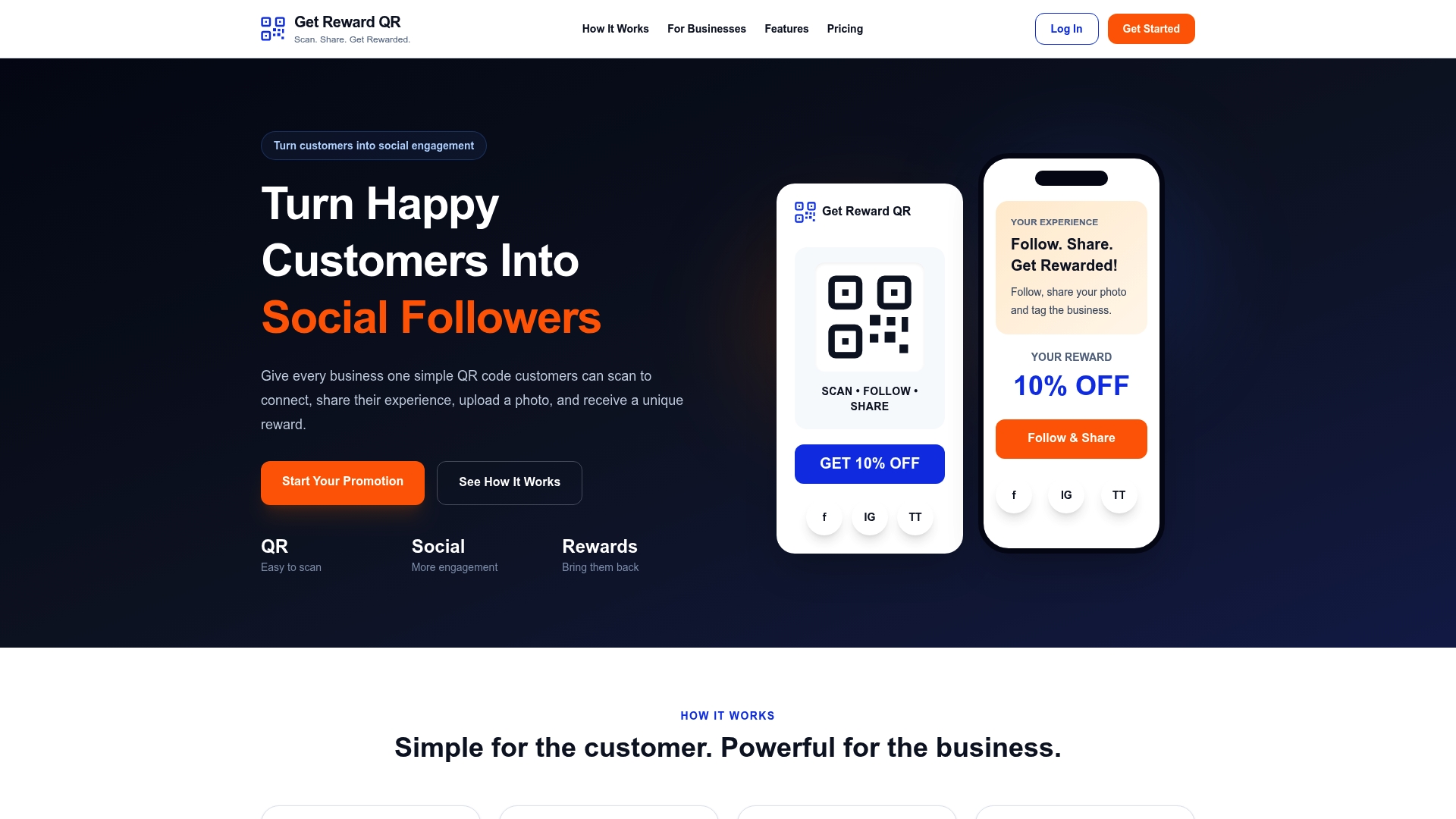
Several ideas above, the digital punch card, the referral offer, the social-share reward, map directly onto how Get Reward QR works. Guests scan a code, complete a quick social action or photo upload, and receive a single-use coupon that staff redeem through a universal POS-compatible mode, without asking anyone to download an app.
- Digital punch replacement: run a repeat-visit reward entirely through QR scans at checkout.
- Social-share campaigns: reward guests for following or tagging the restaurant, turning everyday visits into visible social proof.
- Fast staff redemption: a single-use coupon system that any team member can verify at the register without new hardware.
Get Reward QR offers subscription plans with monthly and annual billing options. Check current pricing and plan details to see which fits your restaurant’s size and rollout timeline.
Sources
- State of the Industry report (National Restaurant Association) — 2025
- Innovations in restaurant loyalty programs (National Restaurant Association resource library)
- US Foods: Restaurant loyalty programs — tips & strategies
- Deloitte: Restaurant loyalty program strategic levers
FAQ
What are some good examples of loyalty ideas for restaurants?
Strong examples include a QR-based digital punch card, points earned per dollar spent, one-click referral rewards, and compact subscription plans offering a recurring perk. The National Restaurant Association found that 78% of consumers are more likely to visit a restaurant where they can earn points, which supports starting with a simple points or punch structure.
What is the 30/30/30 rule for restaurants?
This is not a recognized restaurant loyalty framework covered by the sources here, and definitions circulating online vary widely without a clear authoritative origin. Rather than rely on an unverified rule, focus on the tested design patterns covered above: simplicity, cross-channel consistency, and a mix of transactional and emotional rewards.
What are some creative ideas for loyalty cards?
Beyond a standard punch card, consider a stamp card tied to one specific menu item, a tiered card that unlocks better perks as guests climb levels, or a QR-based version that removes the need for a physical card altogether. Surprise-and-delight touches, like an unannounced free item on a card’s final stamp, add an emotional layer that a plain discount card lacks.
What are some effective loyalty programs for restaurants?
Effective programs share simple rules, consistent rewards across dine-in, takeout, and delivery, and a blend of transactional and emotional perks, according to Deloitte’s loyalty strategy analysis. Programs that centralize tracking across every ordering channel tend to generate more incremental revenue than single-channel efforts, per US Foods’ reporting.
How much does a restaurant loyalty program typically cost to run?
Costs vary widely depending on whether you use a manual punch card, a POS add-on, or a dedicated platform. A QR-based platform like Get Reward QR runs $19.99 per month or $199 per year, which gives a concrete reference point for a low-friction, app-free option.