2026 Loyalty Program Pricing for Local Businesses: Budget + QR Example
2026 Loyalty Program Pricing for Local Businesses: Budget + QR Example

Most small to mid-market businesses should budget $7,720 to $15,320 for a full first year of a loyalty program, according to vendor-backed 2026 benchmarks, with software often the smallest line item. A worked forecasting example follows below so you can plug in your own numbers.
TL;DR:
- A loyalty program’s first-year cost for small to mid-market businesses typically falls between $7,720 and $15,320, with software as a minor expense.
- The four main cost categories are software, reward liability, fulfillment, and marketing, each requiring careful budgeting to avoid overspending early.
- Choosing the right pricing model depends on transaction volume and customer growth, with flat fees suited for stable volume and per-member plans better for expanding businesses.
- Hidden costs like partner onboarding, reconciliation, legal review, and fraud prevention can significantly inflate budgets if not accounted for upfront.
- QR-based, app-free loyalty platforms reduce development costs and enrollment friction, with predictable subscription fees and simpler implementation.
Table of Contents
- Loyalty Program Pricing: The Direct Line-Item Costs
- Which Loyalty Program Pricing Model Fits Your Business?
- How to Forecast Your Loyalty Program Budget for Year One
- The Hidden Costs That Blow Up Loyalty Program Budgets
- Loyalty Program Timelines: When to Expect Results
- What to Check Before Signing a Loyalty Platform Contract
- How QR-Based Loyalty Platforms Change the Cost Equation
- Reward Value Beats Reward Size
- Try an App-Free Loyalty Program Built for Local Businesses
- Sources
- FAQ
Loyalty Program Pricing: The Direct Line-Item Costs
Loyalty program costs break into four buckets: software, reward liability, fulfillment, and marketing. Get these four numbers right and you have a workable budget. Miss one and you’ll blow through your first-year projection by month four.
Software subscriptions run a wide range depending on your business size and feature needs. Entry-level platforms often start free or in the $29 to $99 per month range for basic point tracking and customer profiles. Mid-market tools with automation, segmentation, and integrations typically land between $199 and $499 per month. Enterprise platforms serving multi-location chains or high-volume e-commerce brands move to custom quotes, often starting at several thousand dollars monthly once you factor in dedicated support and advanced analytics. Yotpo’s published pricing shows this tiered structure clearly, with free starter plans giving way to paid tiers that scale with order volume.
Reward liability is the number most businesses underestimate. Here’s the math: multiply the number of points you issue by your point value, then multiply that by your expected redemption rate. Yotpo’s cost calculation guide walks through this exact formula, and it’s the single most useful spreadsheet exercise you’ll do before launch.
Fulfillment costs apply if you offer physical rewards instead of pure discounts or store credit. Branded merchandise, gift cards purchased at face value, or third-party experience rewards all carry a cost of goods sold that sits separate from your points math. Shipping adds another line item if rewards travel by mail rather than getting redeemed in-store.
Marketing and launch costs cover everything from enrollment campaigns to creative assets. A typical small business launch budget includes:
- Email and SMS campaign costs to announce the program to existing customers
- In-store signage, table tents, or point-of-sale materials explaining how to join
- Social media creative (graphics, short video) promoting sign-up incentives
- A launch-week bonus offer to drive first enrollment (often the single highest-cost week of the year)
Industry guidance from Clevertap treats these as recurring rather than one-time costs, since re-engagement campaigns and seasonal promotions continue well past launch.
Put together, a small retailer or restaurant chain might see month-one costs of $2,500 to $4,500 covering setup, initial marketing, and early reward redemptions, scaling to that $7,720 to $15,320 year-one total once reward liability compounds with a growing member base.

Which Loyalty Program Pricing Model Fits Your Business?
Vendors sell loyalty software four different ways, and picking the wrong one for your volume is the fastest way to overpay.
Flat monthly fee models charge one price regardless of how many members join or transactions run through the program. This works well for businesses with predictable, moderate volume. You know your ceiling cost going in, which makes budgeting simple, but you may overpay if you’re a small operation using a tier built for larger stores.
Per-order or usage-based pricing charges based on transaction volume, often billed per 100 orders processed through the loyalty engine. Joy’s pricing structure illustrates this well: a free order threshold covers light usage, then overage fees kick in per additional block of orders. This model rewards low-volume businesses and penalizes high-growth ones, since your software bill climbs in step with sales.
Per-member pricing charges a rate for each enrolled customer, sometimes with tiered discounts at higher member counts. This model makes the most sense when you expect steady enrollment growth and want your software cost to scale predictably alongside your customer base rather than transaction count.

Revenue share arrangements take a percentage of sales attributed to loyalty members or redemptions. Less common outside larger retail platforms, this model aligns vendor incentives with your growth but can get expensive fast once the program actually works.
Here’s how the models typically map to business size:
- Very small merchants (under $250,000 in annual revenue): flat fee or free tier, usually $0 to $99 per month
- Growing businesses ($250,000 to $2 million): per-order or per-member pricing in the $99 to $499 range
- Multi-location or enterprise operators: custom enterprise pricing, often $1,000+ monthly with negotiated terms
Pro Tip: Before signing anything, ask the vendor to model your actual order volume from the last three months against their overage rules. Free tiers look generous until your busiest month triggers three separate overage charges you didn’t see coming.
How to Forecast Your Loyalty Program Budget for Year One
Building a defensible budget takes five inputs and three simple formulas. Here’s the sequence:
- Estimate points issued. Multiply your projected annual transactions by your earning rate (points per dollar spent).
- Apply your point value. Most programs value points between $0.01 and $0.05 each. Multiply points issued by point value to get total face-value liability.
- Apply an expected redemption rate. Not every point gets redeemed. EY’s 2026 loyalty study puts common redemption rates between 61% and 80%, though your own historical data (or a conservative 50% estimate for a brand-new program) should override an industry average.
- Add software and marketing costs from the categories covered above.
- Sum for your year-one total, then divide by 12 for a monthly cash-flow view.
Here’s a worked example. A salon chain with $800,000 in annual revenue enrolls customers at a 1 point per dollar rate, spending on average $65 per visit.
Add a mid-tier software subscription at $199 per month ($2,388 annually), plus $1,500 in launch marketing and $1,200 in ongoing campaign costs, and total year-one spend comes to roughly $7,168. That sits comfortably within the $7,720 to $15,320 benchmark range for small-to-mid operators.
Statistic Callout: Programs benchmarked by EY commonly see ROI in the 20% to 30% range once fully operational, meaning that $7,168 spend should aim to return $8,600 to $9,300 in incremental profit to hit the middle of that benchmark.
Break-even timing depends heavily on two levers: enrollment speed and redemption rate. If enrollment lags projections, your reward liability drops (good for cash flow, bad for engagement). If redemption runs higher than expected, you’ll hit your liability ceiling faster but likely see stronger repeat-purchase behavior offsetting the cost.
The Hidden Costs That Blow Up Loyalty Program Budgets
Software and rewards are the costs you plan for. The ones that catch businesses off guard live in categories nobody puts on a pricing page.
Currency Alliance’s guidance on total cost of ownership breaks program spend into capex (one-time technology and integration costs) and opex (ongoing rewards, staffing, and campaign costs).
Costs that rarely make it into a first-draft budget include:
- Partner onboarding fees when you integrate third-party reward partners (gift card networks, experience providers, co-branded offers)
- Reconciliation labor for matching points issued against redemptions, especially across multiple locations or POS systems
- Legal review of program terms, privacy policy updates, and state-specific gift card or breakage regulations
- Fraud prevention tooling or manual review to catch point-farming and coupon abuse
Breakage (points issued but never redeemed) deserves a specific mention. It’s tempting to treat unredeemed points as pure profit, and to some extent they are. But a program engineered to maximize breakage is a program that isn’t driving the repeat visits you built it for in the first place. Plan for breakage in your accounting; don’t design toward it.
Pro Tip: Audit your existing tech stack before adding a loyalty platform. Legacy CRM or email tools doing overlapping work often get absorbed or dropped once loyalty software takes over segmentation, which can offset new subscription costs by more than you’d expect.
Loyalty Program Timelines: When to Expect Results
A realistic rollout looks like three phases, each with its own metrics to watch.
Launch (weeks 1 to 4): Focus on enrollment volume and sign-up friction. Track how many transactions include a loyalty sign-up prompt versus how many converts.
Three-month mark: Shift attention to redemption rate and average order value among enrolled members versus non-members. This is your first real signal of whether the reward structure motivates behavior or just sits unused.
Six to twelve months: This is where most businesses see genuine payback, assuming steady enrollment and a redemption rate that tracks with your forecast. Watch repeat-purchase frequency specifically, since that’s the metric that separates a program paying for itself from one that’s just a cost center with a nice app.
Key metrics to track at each phase:
- Enrollment rate as a percentage of total transactions
- Redemption rate against points issued
- Average order value lift for members versus non-members
- Repeat purchase frequency, pre- and post-enrollment
Payback timing varies most based on enrollment speed and how compelling your reward tiers are relative to your margins. A program with weak early enrollment can push break-even past the 12-month mark even with strong per-member economics.
What to Check Before Signing a Loyalty Platform Contract
The sticker price on a vendor’s homepage rarely reflects what you’ll actually pay. Score any platform against these operational requirements before signing:
- POS integration compatibility with your existing checkout system, not just a generic API that requires custom development
- Reporting and analytics depth covering redemption rate, member lifetime value, and cohort comparisons, not just enrollment counts
- Data ownership terms specifying who controls customer data if you switch vendors later
- Overage definitions spelled out in dollars per unit, not vague “fair use” language that leaves pricing ambiguous
- Implementation fees disclosed upfront rather than added after the sales call
| Evaluation criteria | Why it changes true cost |
|---|---|
| POS/API integration | Custom integration work can add thousands beyond the subscription |
| Overage billing structure | Usage spikes during promotions can double a monthly bill |
| Data export rights | Vendor lock-in costs you leverage and money at renewal time |
| Implementation fee transparency | Hidden onboarding fees often equal one to two months of subscription |
Score vendors on total expected annual cost including these factors, not the number on their pricing page.
How QR-Based Loyalty Platforms Change the Cost Equation
App-free, QR-based platforms shift where your money goes. Since customers scan a code instead of downloading an app, there’s no app development cost, no app store maintenance, and no friction-driven enrollment drop-off that typically kills sign-up rates for app-based programs.
Costs shift rather than disappear:
- Less spent on development and app maintenance
- More spent on signage and printed QR materials at point of sale
- Staff training on redemption workflows since coupons get validated in-person rather than through automated app scanning
Get Reward QR applies this model specifically for restaurants, gyms, and salons, running the entire program through scannable codes that connect customers to social sharing and reward redemption. Compare total cost of ownership against app-based alternatives before deciding, since the pricing page lays out the subscription side plainly, but your signage and staffing line items will look different from a traditional app rollout.
Reward Value Beats Reward Size
Businesses obsess over discount percentage when they should obsess over perceived value.
Start small. Launch with a modest reward structure, measure redemption and repeat-visit behavior for 90 days, then reallocate budget from whatever isn’t working, usually broad marketing spend, toward the reward mechanics that actually move behavior. Businesses that treat their first loyalty budget as fixed rather than adjustable tend to overspend on channels that looked good on paper and underspend on the reward tweaks that would have doubled retention.
The businesses getting this right aren’t the ones with the biggest discount. They’re the ones paying attention to which specific reward triggers a second visit, then quietly doubling down on that one lever while cutting everything else.
— Arturo
Try an App-Free Loyalty Program Built for Local Businesses
An app-free QR-based loyalty platform reduces the biggest hidden cost: app development and the enrollment friction that comes with asking customers to download something before they can earn a reward. Such platforms enable restaurants, gyms, salons, and retail shops to run reward campaigns through a scannable code, often including social sharing, photo tagging, coupon generation, and point-of-sale redemption features without app maintenance costs.
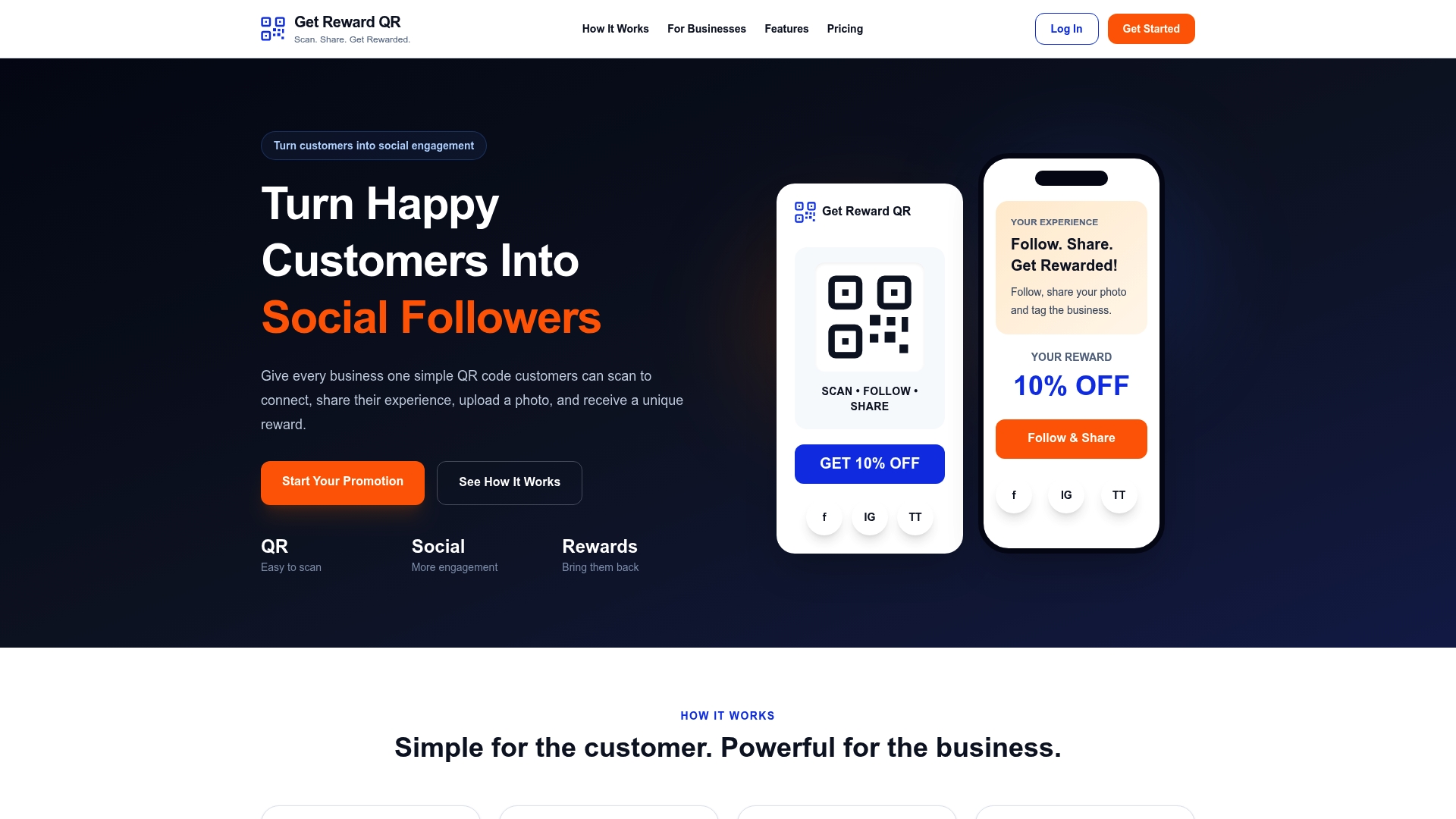
That app-free structure changes your cost lines the way this guide described: less spent on development and integration, more on signage and staff training, and a subscription cost you can see upfront. Pricing runs $19.99 per month or $199 per year, both starting with a free trial so you can test enrollment and redemption behavior before committing a full year’s budget. Check the pricing page and start a trial to see how the numbers look for your own location.
Sources
These are the primary sources behind the cost ranges and formulas in this guide:
- Calculating total cost of ownership in a loyalty program | Currency Alliance
- EY loyalty study report (2026)
- Loyalty Program Cost: $2,500–$15,320 in Year One (2026) · Joy
FAQ
How Much Are 10,000 Loyalty Points Worth?
At a typical point value of $0.01, points equal their face value. Actual redeemed value depends on your redemption rate, which EY’s 2026 benchmark puts commonly between 61% and 80%, meaning many businesses only pay out a portion of that face value in practice.
How Do Companies Make Money From Loyalty Programs?
Loyalty programs generate revenue indirectly by increasing repeat purchase frequency and average order value among enrolled members compared to non-members. Companies also profit from breakage, unredeemed points, though a program designed around maximizing breakage tends to undermine the retention it’s meant to drive.
Is There a Free App for Customer Loyalty?
Several vendors offer free starter tiers with basic point tracking, though features are limited compared to paid plans. Get Reward QR takes a different approach entirely, skipping the app altogether in favor of a QR-based system, and offers a free trial before its $19.99 monthly or $199 annual subscription applies.
What Are the Top Loyalty Programs?
Rankings vary by industry and methodology, and no single authoritative list of top loyalty programs exists across all sectors. Rather than chasing a specific ranking, focus on programs within your own industry category (restaurant, retail, fitness) that match your budget tier and enrollment friction tolerance.
How Much Does Get Reward QR Cost?
Get Reward QR is priced at $19.99 per month or $199 per year, with a free trial available before billing starts. Both plans cover the full QR-based reward campaign system, including social sharing steps, coupon generation, and point-of-sale redemption.